




LATEST INSIGHTS
Check out our latest Technology Insights
25 Aug, 2026
The wrong app development company rarely looks like a bad choice on the first sales call, but missed sprints and expanding scope can quickly put your product launch at risk. Furthermore, Australian projects often require specific expertise in compliance, accessibility, payments, and regulated digital services that generalist vendors may not offer. This article compares five leading app development company in Australia using verified project outcomes, pricing benchmarks, sector strengths, and delivery trade-offs. As a result, you can select a partner that fits your product, budget, and compliance requirements before signing a contract.
Key Takeaways
- Market size: Australia’s app development market is projected to reach $2.81 billion by 2033 (Source: Statista/Grand View Research, 2025), driven by fintech, health tech, government digital transformation, and retail automation.
- Cost range: Senior developer rates run $95 to $250 AUD per hour depending on the city; offshore hybrid models typically reduce that by 40% to 60%.
- Compliance first: Any vendor without live production deployments under your specific regulatory framework carries delivery risk that won’t surface until the project is already underway.
- Real benchmark: Code Heroes built the Queensland Digital Licence – Australia’s first ISO 18013-5 government digital credential – which reached 500,000 active users in seven months with a 94% satisfaction rating.
21 Aug, 2026
Germany offers hundreds of app development vendors, yet a strong portfolio does not guarantee that a team can handle GDPR architecture or regulated enterprise requirements. Moreover, overlooked work such as consent management, audit logging, and right-to-erasure workflows can increase both engineering time and project cost after the contract is signed.
This article compares 5 leading app development companies in Germany across pricing, technical expertise, compliance depth, and sector experience. Therefore, you can build a shortlist based on delivery evidence rather than polished sales proposals.
Key Takeaways
- Germany’s mobile app market reached €12.65 billion in 2024 and is growing toward €49.6 billion by 2035 (Statista), making it Europe’s largest app market by revenue.
- GDPR-compliant architecture adds measurable engineering time: consent management UX (3-5 days), audit trail schema (2-3 days), right-to-erasure API per integration (1-2 days each).
- German agencies charge €70-€200/hr. Verified offshore partners offer comparable delivery at $25-$70/hr, cutting total project cost by 40-60%.
- Clutch scores confirm client satisfaction but don’t reveal compliance depth. Always verify with a named reference call in your specific industry.
- Offshore partners like AHT Tech are increasingly used alongside German agencies for cost-efficiency, provided they demonstrate GDPR-aware architecture and ISO-certified QA.
14 Aug, 2026
Cloud adoption is no longer simply about moving workloads away from on-premise infrastructure. For many businesses, the bigger question is how to build a cloud environment that can continue scaling as application demand, data volumes, AI workloads, geographic reach, and operational requirements grow.
A single-cloud strategy allows organizations to concentrate their applications and infrastructure within one cloud ecosystem, potentially simplifying management, security, skills development, and cost control. Multi-cloud, on the other hand, enables businesses to use cloud services from multiple providers, potentially increasing workload flexibility, geographic coverage, technology choice, and resilience.
But using more cloud providers does not automatically create a more scalable environment.
The better question is:
Which cloud strategy enables the business to scale performance, operations, security, and cost without introducing unnecessary complexity?
Flexera’s 2026 State of the Cloud Report found that 73% of surveyed organizations now operate hybrid cloud estates, while estimated wasted cloud spend has risen to 29%. These numbers indicate that enterprises are expanding their cloud footprints, but many are also struggling to manage the financial and operational consequences of that expansion.
This article compares multi-cloud vs single-cloud strategies from a scalability perspective and explores how businesses can determine which approach is better suited to their long-term cloud requirements.
30 Jul, 2026
Choosing an enterprise resource planning (ERP) system involves more than comparing software features. Businesses must also decide where the ERP platform will be hosted, how it will be maintained, and who will be responsible for its security, performance, and availability.
This is why the decision of ERP model has become a critical part of modern ERP planning.
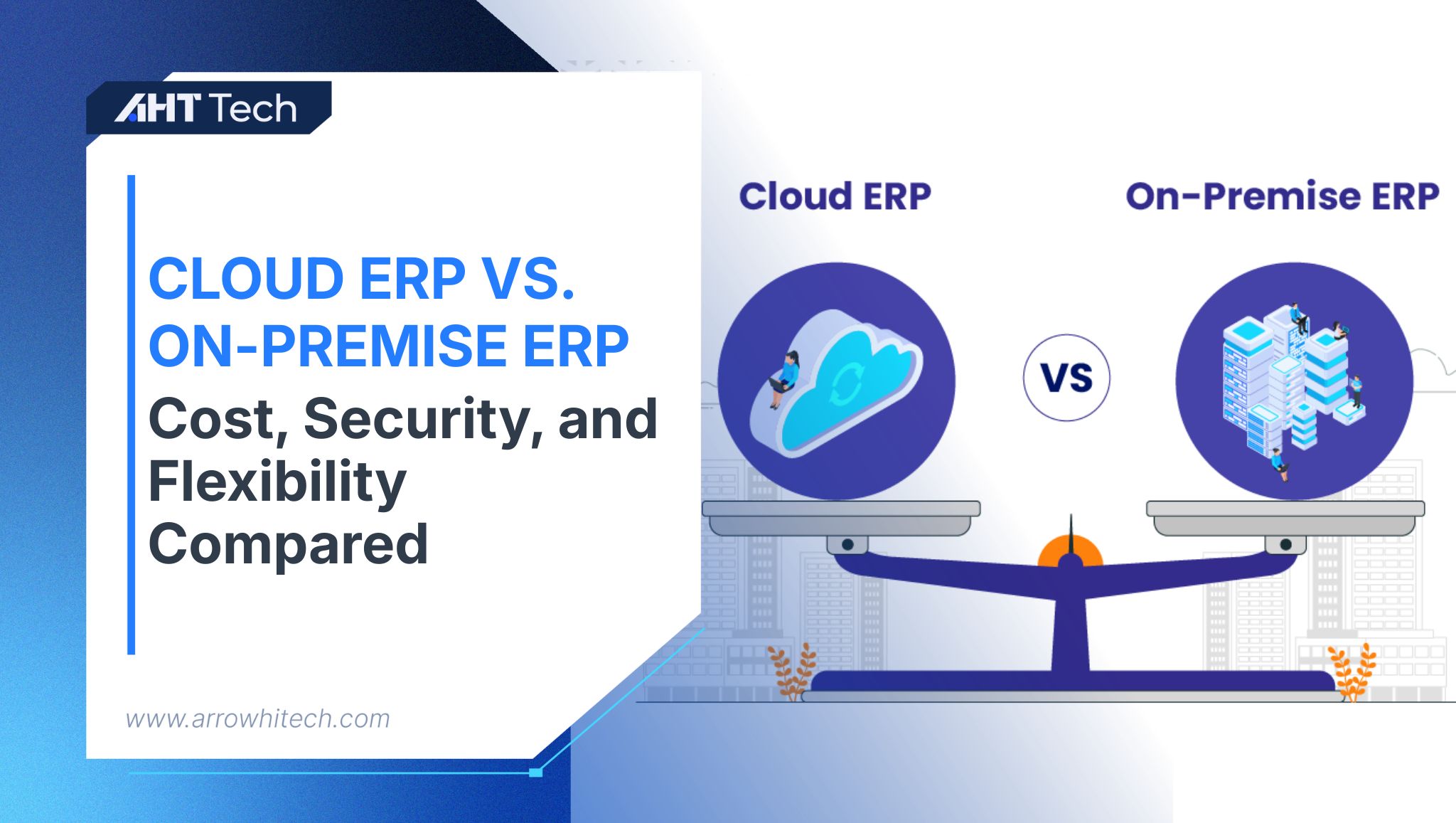
Cloud ERP operates on infrastructure managed by an ERP vendor or cloud service provider. Users normally access the system through a web browser or mobile application and pay recurring subscription fees. On-premise ERP is installed on infrastructure controlled by the business, requiring the organisation to manage servers, databases, networks, backups, security, and upgrades.
The right choice in a cloud ERP vs on-premise ERP comparison depends on much more than initial software pricing. Businesses must consider capital expenditure, operating costs, cybersecurity capabilities, disaster recovery, remote access, customisation, scalability, and long-term maintenance.
This article provides a detailed analysis between cloud ERP and on-premise ERP to help decision-makers evaluate which deployment model best supports their operational requirements and growth strategy.
Explore More
- Industry
- Education & EdTech
- BFSI & Fintech
- Retail & e-Commerce
- Startup
- Healthcare
- Manufacturing
- Wholesale & Distribution
- Logistics & Supplychain
- Expertise
- Magento
- Shopify
- Bigcommece
- Tableau
- Databricks
- Others
- BPM
- Java
- Oracle
- Tibco
- Microservices
- Angular
- Odoo
- SQL
- Acumatica
- Salesforce Sales Cloud Pardot
- Liferay
- Flutter
- Salesforce
- Java Spring Boot
- Platform
- CMS
- Managed Service
- SaaS
- Design
- Data Science
- AI/IoT
- Others
- ESB Development
- CX Consulting & Development
- Website Development
- Mobile App development
- ERP
- Ecommerce
25 Aug, 2026
The wrong app development company rarely looks like a bad choice on the first sales call, but missed sprints and expanding scope can quickly put your product launch at risk. Furthermore, Australian projects often require specific expertise in compliance, accessibility, payments, and regulated digital services that generalist vendors may not offer. This article compares five leading app development company in Australia using verified project outcomes, pricing benchmarks, sector strengths, and delivery trade-offs. As a result, you can select a partner that fits your product, budget, and compliance requirements before signing a contract. Key Takeaways Market size: Australia’s app development market is projected to reach $2.81 billion by 2033 (Source: Statista/Grand View Research, 2025), driven by fintech, health tech, government digital transformation, and retail automation. Cost range: Senior developer rates run $95 to $250 AUD per hour depending on the city; offshore hybrid models typically reduce that by 40% to 60%. Compliance first: Any vendor without live production deployments under your specific regulatory framework carries delivery risk that won’t surface until the project is already underway. Real benchmark: Code Heroes built the Queensland Digital Licence – Australia’s first ISO 18013-5 government digital credential – which reached 500,000 active users in seven months with a 94% satisfaction rating.

21 Aug, 2026
Germany offers hundreds of app development vendors, yet a strong portfolio does not guarantee that a team can handle GDPR architecture or regulated enterprise requirements. Moreover, overlooked work such as consent management, audit logging, and right-to-erasure workflows can increase both engineering time and project cost after the contract is signed. This article compares 5 leading app development companies in Germany across pricing, technical expertise, compliance depth, and sector experience. Therefore, you can build a shortlist based on delivery evidence rather than polished sales proposals. Key Takeaways Germany’s mobile app market reached €12.65 billion in 2024 and is growing toward €49.6 billion by 2035 (Statista), making it Europe’s largest app market by revenue. GDPR-compliant architecture adds measurable engineering time: consent management UX (3-5 days), audit trail schema (2-3 days), right-to-erasure API per integration (1-2 days each). German agencies charge €70-€200/hr. Verified offshore partners offer comparable delivery at $25-$70/hr, cutting total project cost by 40-60%. Clutch scores confirm client satisfaction but don’t reveal compliance depth. Always verify with a named reference call in your specific industry. Offshore partners like AHT Tech are increasingly used alongside German agencies for cost-efficiency, provided they demonstrate GDPR-aware architecture and ISO-certified QA.
14 Aug, 2026
Cloud adoption is no longer simply about moving workloads away from on-premise infrastructure. For many businesses, the bigger question is how to build a cloud environment that can continue scaling as application demand, data volumes, AI workloads, geographic reach, and operational requirements grow. A single-cloud strategy allows organizations to concentrate their applications and infrastructure within one cloud ecosystem, potentially simplifying management, security, skills development, and cost control. Multi-cloud, on the other hand, enables businesses to use cloud services from multiple providers, potentially increasing workload flexibility, geographic coverage, technology choice, and resilience. But using more cloud providers does not automatically create a more scalable environment. The better question is: Which cloud strategy enables the business to scale performance, operations, security, and cost without introducing unnecessary complexity? Flexera’s 2026 State of the Cloud Report found that 73% of surveyed organizations now operate hybrid cloud estates, while estimated wasted cloud spend has risen to 29%. These numbers indicate that enterprises are expanding their cloud footprints, but many are also struggling to manage the financial and operational consequences of that expansion. This article compares multi-cloud vs single-cloud strategies from a scalability perspective and explores how businesses can determine which approach is better suited to their long-term cloud requirements.
30 Jul, 2026
Choosing an enterprise resource planning (ERP) system involves more than comparing software features. Businesses must also decide where the ERP platform will be hosted, how it will be maintained, and who will be responsible for its security, performance, and availability. This is why the decision of ERP model has become a critical part of modern ERP planning. Cloud ERP operates on infrastructure managed by an ERP vendor or cloud service provider. Users normally access the system through a web browser or mobile application and pay recurring subscription fees. On-premise ERP is installed on infrastructure controlled by the business, requiring the organisation to manage servers, databases, networks, backups, security, and upgrades. The right choice in a cloud ERP vs on-premise ERP comparison depends on much more than initial software pricing. Businesses must consider capital expenditure, operating costs, cybersecurity capabilities, disaster recovery, remote access, customisation, scalability, and long-term maintenance. This article provides a detailed analysis between cloud ERP and on-premise ERP to help decision-makers evaluate which deployment model best supports their operational requirements and growth strategy.
29 Jul, 2026
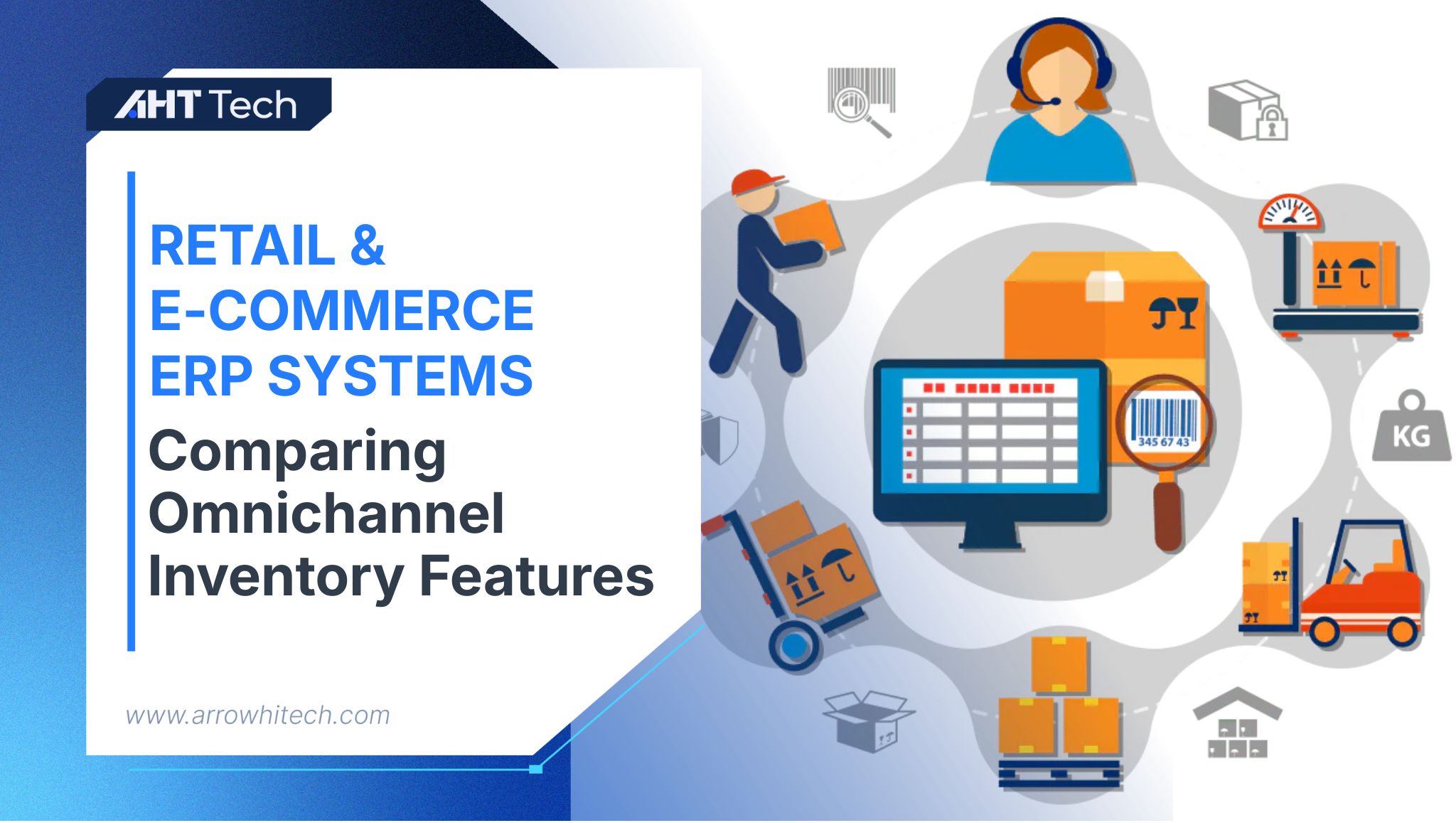
Retailers no longer operate through a single sales channel. A customer may discover a product on social media, check its availability on a website, purchase it through a mobile app, collect it from a nearby store and later return it at another location. Behind this seemingly simple experience is a complex chain of inventory, payment, fulfilment and financial processes. The challenge is that many retail businesses still manage eCommerce, point-of-sale systems, warehouses and accounting through separate applications. Stock movements are transferred between systems through scheduled integrations, spreadsheets or manual updates. Consequently, the inventory shown online may not reflect what is actually available in stores or warehouses. This is why a retail ERP system comparison should look beyond accounting, purchasing and basic inventory control. The most important question is whether the platform can coordinate inventory and orders across every channel in near real time. This guide compares five leading omnichannel ERP systems, focusing on three capabilities that have a direct impact on retail performance: Multi-warehouse inventory synchronisation BOPIS, or Buy Online, Pick Up In Store Point-of-sale and eCommerce integrations Rather than declaring one universal winner, this comparison identifies which ERP is most suitable for different retail operating models.
20 Jul, 2026
Mobile applications now sit at the center of banking, healthcare, retail, logistics, education, and employee operations. They also collect some of the most sensitive information an organization handles: identity details, payment data, location history, health records, behavioral signals, and device identifiers. As global privacy expectations rise, the way an application collects, processes, stores, and deletes this information can determine whether it earns user trust, passes enterprise security reviews, or reaches an app marketplace successfully. For modern mobile app development, privacy cannot be added during final testing. It must influence product discovery, architecture, interface design, API development, analytics, infrastructure, and post-launch operations. The strongest teams treat privacy as a product capability: users understand what is collected, sensitive actions receive stronger protection, and unnecessary data never enters the system. This article explores how zero-trust architecture, hardware-backed security, local data processing, and privacy-by-design practices can help businesses build secure mobile app development that are ready for both regulatory review and long-term user adoption.

14 Jul, 2026
For many eCommerce businesses, the most stressful part of running a Magento store isn’t preparing for Black Friday, launching a new product line, or managing thousands of daily orders. Updating – What should be a routine maintenance task often becomes an all-night emergency. Developers stay online until two in the morning. Marketing teams postpone campaigns because they’re afraid the website might fail. Customer service prepares for complaints before a deployment even begins. Business owners refresh the homepage every few seconds, hoping checkout still works. If this sounds familiar, you’re not alone. Many organizations have developed an unhealthy relationship with Magento updates, not because Magento is unreliable, but because their development process is. Professional Magento development services approach software updates very differently. Instead of treating every deployment as a high-risk event, they rely on engineering disciplines that have been refined over decades in enterprise software development. Staging environments, automated regression testing, version control, deployment pipelines, and rollback strategies transform updates from moments of panic into predictable business operations. This article explains why Magento upgrades often go wrong, why they shouldn’t, and how experienced Magento development services ensure customers never notice an update happening at all.

01 Jul, 2026
The internet has never had more content. Unfortunately, it has also never had more forgettable content. Across industries, websites are being filled with generic AI-generated blogs, recycled listicles, vague thought leadership, and keyword-heavy pages that sound almost identical to competitors. Many of these articles are not written to educate customers. They are produced to fill a content calendar as quickly and cheaply as possible. This is the problem now often called AI slop: low-quality, repetitive, machine-generated content that adds little original value. For businesses, the risk is serious. Search engines and AI search assistants are becoming more selective about which sources they trust, summarize, cite, and recommend. Google’s own guidance states that using automation, including AI, to generate content primarily to manipulate search rankings violates its spam policies. It also emphasizes that ranking systems are designed to reward helpful, reliable, people-first content rather than content created mainly for search engines. At the same time, AI search tools such as ChatGPT, Perplexity, Gemini, and Google AI Overviews are changing how customers discover brands. Instead of scrolling through ten blue links, users increasingly ask direct questions and receive summarized answers. A 2026 empirical study on generative AI search found that Google AI Overviews were generated for 51.5% of representative real-user queries in its benchmark, showing how often AI-generated answers can appear above traditional organic results. This shift creates a new challenge for companies: it is no longer enough to “rank” for keywords. Your content must be credible enough to be cited, summarized, and recommended by both search engines and AI answer engines. Professional digital marketing services are moving beyond basic SEO execution and AI-assisted content production. The new standard combines organic search strategy, brand authority marketing, human editorial oversight, technical optimization, structured schema markup, and generative engine optimization (GEO). The goal is to become the source that customers, search engines, and AI assistants trust.

30 Jun, 2026
For many in-house marketing managers, the phrase website audit sounds more technical than it needs to be. You may already know that your website needs improvement: Maybe traffic is flat, your service pages are not generating enough leads, your blog posts are getting impressions but very few clicks, or maybe your developers, SEO agency, or leadership team keep talking about “indexing,” “Core Web Vitals,” “crawlability,” “metadata,” and “structured data” until the conversation becomes hard to follow. A technical website audit does not have to begin with complicated dashboards or advanced SEO tools. For marketing teams, the first goal is not to solve every technical problem immediately but is to understand what is working, what is broken, what is slowing growth, and what needs expert support. This guide is designed for non-technical marketing managers who need a practical starting point. It explains how to audit a website in nine clear steps, using accessible checks and free SEO audit tools such as Google Search Console, PageSpeed Insights, and basic manual review. Google Search Console is especially important because it helps website owners measure search traffic, understand how Google sees their pages, inspect URLs, and receive alerts when Google finds issues. PageSpeed Insights is also useful because it helps evaluate whether pages are fast and usable across devices.
SUBSCRIPTION
Find Them Useful?
Subscribe our newsletter to receive the latest news and exclusive advice package from our experts. No spam.