


AI Strategic Consulting: Comprehensive Guide in 2026

TABLE OF CONTENT
What Is AI Strategy Consulting and Why Does It Matter Now?
Core Components of an Executable AI Strategy
The Typical AI Strategic Consulting Engagement
Cost, Expected Deliverables, and the Path From Pilot to Production
How to Choose an AI Strategy Consultant and Avoid Common Failure Modes
Conclusion
AI adoption reached 88% of surveyed organizations in 2025, according to the Stanford 2026 AI Index, yet AI agent deployment remained in the single digits across nearly all business functions. That gap shows why technology access does not automatically create operating value. Therefore, this guide explains how AI strategic consulting converts ambition into prioritized investments, governed delivery, and measurable production outcomes.
Key Takeaways
AI strategic consulting helps executives decide where AI can create business value, what data and technology foundations each use case requires, how the organization will govern risk, and which initiatives deserve funding. A complete engagement should produce prioritized use cases, business cases, architecture principles, governance controls, owners, KPIs, and an executable roadmap rather than a list of technology ideas.
- Strategy before tools: Consultants should define outcomes, workflows, data, risk, and adoption requirements before selecting models or platforms.
- Production path: Every pilot needs a business owner, baseline metric, target, operating model, integration plan, and explicit decision gate for scaling.
- Governance by design: Risk classification, human oversight, evaluation, monitoring, privacy, and change approval belong in the roadmap from the start.
What Is AI Strategy Consulting and Why Does It Matter Now?
AI strategy consulting aligns artificial intelligence investments with business goals, operational workflows, data readiness, technology architecture, governance, workforce adoption, and financial outcomes. The work helps leadership decide what to build, buy, partner for, postpone, or reject.

Strategic AI consulting differs from implementation. Strategy defines the destination, sequencing, controls, investment logic, and decision rights, while implementation builds and operates the selected systems. However, an effective strategy must remain technically credible enough to survive contact with real data, legacy applications, security review, and user adoption.
AHT Tech’s AI strategic advisory and consulting services cover readiness assessment, use-case prioritization, governance, vendor selection, build-vs-buy-vs-hire analysis, change management, and phased roadmap design.
Why AI Strategy Matters in 2026
Organizations now face more capable models, lower experimentation barriers, and faster competitive cycles. PwC argues that companies need to embed AI into value chains, align leadership around an AI vision, and prioritize initiatives that demonstrate scalable value. Meanwhile, Stanford reports that organizational adoption reached 88 percent, but agent deployment remains early. Consequently, leaders need a disciplined portfolio approach instead of disconnected pilots.
Core Components of an Executable AI Strategy
A useful AI strategy should simplify investment decisions. Specifically, the final package should connect business value, data readiness, architecture, governance, delivery capacity, and adoption into one operating plan.
|
Strategy Component |
Key Question |
Required Output |
| Executive vision | Which business outcomes should AI improve? | North star, value pools, constraints, and decision principles |
| Readiness assessment | Can current data, systems, people, and controls support AI? | Maturity baseline, gaps, dependencies, and remediation plan |
| Use-case prioritization | Which ideas offer the best value-to-feasibility ratio? | Scored portfolio with owners, KPIs, cost, risk, and time to value |
| Data and architecture | How will models access trusted data and business systems? | Target architecture, integration principles, hosting, and model options |
| Governance and risk | How will the organization approve, monitor, and control AI? | Policies, RACI, risk tiers, evaluation gates, human oversight, and audit trails |
| Sourcing strategy | Should the company build, buy, or hire? | Three- and five-year TCO, vendor criteria, and capability plan |
| Adoption model | How will employees change their workflows? | Training, communications, process redesign, support, and KPI dashboards |
| Delivery roadmap | What should happen first, next, and later? | 12- to 24-month sequence with milestones and investment gates |
Organizations should also align governance with recognized frameworks. NIST AI RMF organizes risk work around Govern, Map, Measure, and Manage, while ISO/IEC 42001 provides an AI management-system standard.
The EU AI Act also introduces risk-based obligations that affect governance, transparency, and oversight decisions.
The Typical AI Strategic Consulting Engagement
A structured engagement moves from evidence to decisions. Although scope varies by organization, a practical strategic AI consulting process normally includes five connected phases.
- Discovery and readiness assessment: Consultants interview executives and process owners, inventory current initiatives, review data and systems, and identify blockers across governance, talent, and architecture.
- Use-case workshops: Cross-functional teams translate business problems into candidate use cases and define affected workflows, users, data, integrations, risks, and potential KPIs.
- Prioritization and business cases: The team scores each use case by value, feasibility, data readiness, implementation effort, risk, and adoption complexity, then models the strongest opportunities.
- Roadmap and governance design: Consultants sequence quick wins, foundational work, and strategic bets while defining policies, approvals, evaluation, monitoring, and accountability.
- Executive alignment and implementation handoff: Leadership confirms investment gates, owners, KPIs, sourcing decisions, and the transition from strategy into engineering and change management.
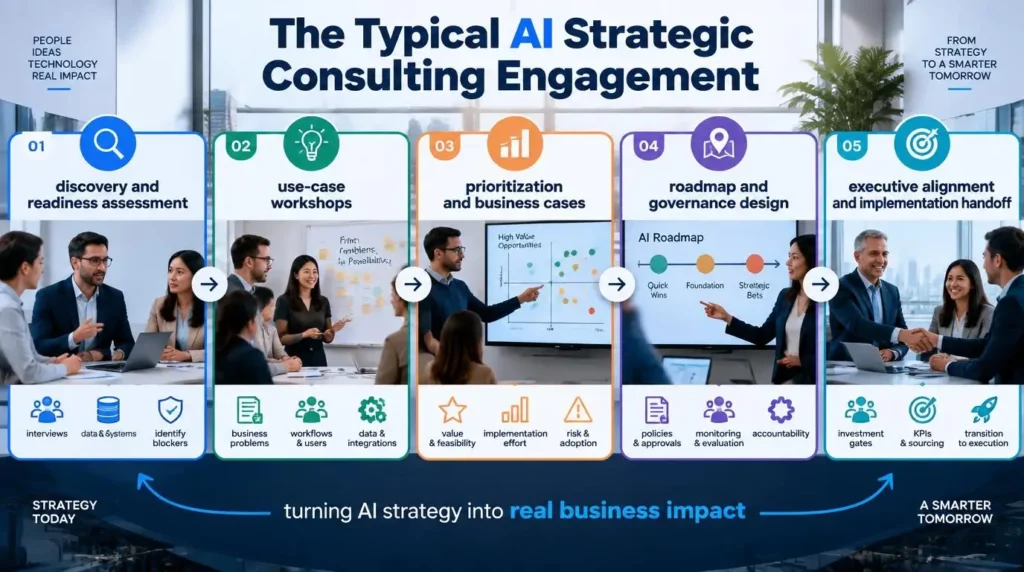
AHT Tech states that its advisory engagements produce readiness findings, prioritized business cases, a 12- to 24-month roadmap, governance design, RACI charts, and KPIs. Accordingly, the engagement aims to create implementation-ready artifacts rather than a strategy deck that remains disconnected from delivery.
Cost, Expected Deliverables, and the Path From Pilot to Production
AI strategy consulting costs vary widely because a two-week executive assessment differs from an enterprise program that covers several countries, business units, data domains, and regulatory environments.
Public sources rarely disclose comparable fee cards, so buyers should avoid treating any single market estimate as a universal price.
|
Engagement Type |
Indicative Planning Range | Typical Scope |
Expected Deliverables |
| Focused readiness assessment | $15,000 to $40,000 | One function or business unit | Maturity baseline, opportunity map, major gaps, next-step plan |
| Use-case and roadmap sprint | $30,000 to $80,000 | Several functions and a prioritized portfolio | Use-case scoring, business cases, roadmap, architecture principles |
| Enterprise AI strategy program | $75,000 to $250,000+ | Multiple business units, jurisdictions, and stakeholders | Operating model, governance, vendor strategy, portfolio, phased roadmap |
| Strategy-to-pilot engagement | $100,000 to $500,000+ | Strategic planning plus one or more validated pilots | Roadmap, controls, pilot delivery, evaluation, adoption plan, scale decision |
These figures are editorial planning ranges, not published AHT Tech prices or guaranteed market averages.
Therefore, buyers should request a proposal that separates advisory fees, workshops, data analysis, architecture work, governance design, pilot engineering, cloud or model costs, training, and post-engagement support.
Top 5 Evidence-Based Patterns Behind AI Programs That Scale
Public research does not support a single universal formula for AI success. Nevertheless, scaled programs repeatedly share five operating patterns that leadership teams can test before approving additional pilots.
- A business owner owns the outcome: The use case has an accountable executive and process owner, not only a technical sponsor.
- The team establishes a measurable baseline: The business records current cycle time, cost, quality, conversion, risk, or service levels before the pilot begins.
- The roadmap funds foundations and applications together: Data quality, integration, identity, evaluation, monitoring, and governance receive budget alongside model development.
- The operating model includes human decisions: Teams define when AI may act, when a user must approve, and how the organization escalates exceptions.
- Leadership scales only validated value: The steering group uses explicit performance, risk, adoption, and cost gates before expanding a pilot.
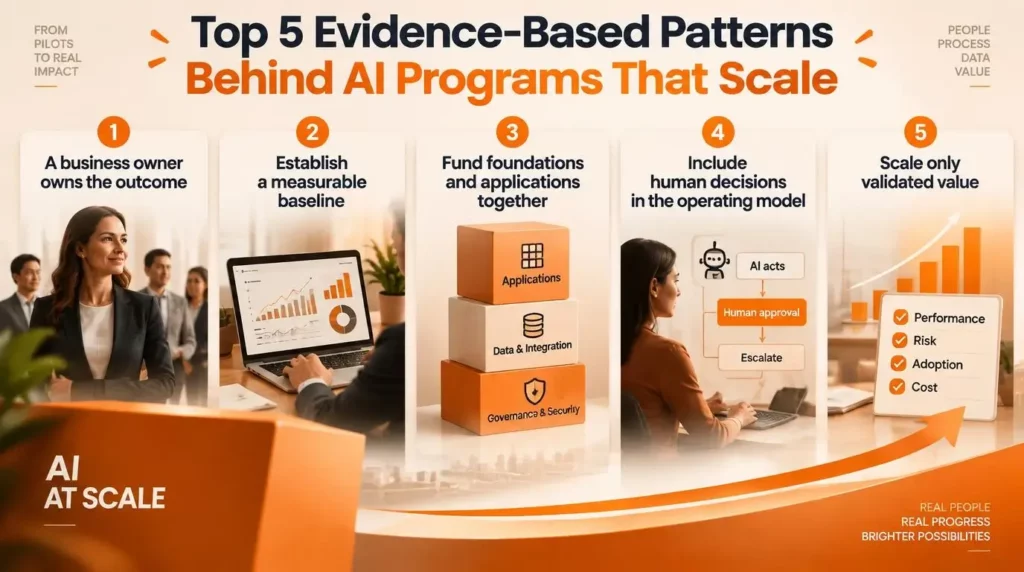
This section summarizes evidence-based patterns rather than claiming five confidential AHT Tech client engagements.
That distinction protects E-E-A-T because the available public sources do not provide five comparable AHT Tech strategy cases with verified deployment numbers.
How to Choose an AI Strategy Consultant and Avoid Common Failure Modes
The right AI strategy consultant connects executive priorities with data, architecture, governance, and implementation reality.
Therefore, buyers should evaluate whether a firm can challenge weak use cases, quantify uncertainty, and stay accountable through the transition into delivery.
- Business-first discovery: The consultant should begin with value pools, process pain, risk, and adoption rather than a preferred model or platform.
- Technical credibility: The team should understand enterprise data, APIs, cloud and on-premise deployment, model evaluation, security, monitoring, and integration constraints.
- Governance capability: The firm should translate NIST, ISO/IEC 42001, privacy rules, sector requirements, and the EU AI Act into usable policies and checkpoints.
- Commercial independence: The recommendation should compare build, buy, and partner options instead of forcing every use case onto one vendor stack.
- Implementation continuity: The consultant should provide clear handoff artifacts or remain involved during pilot design, engineering, change management, and production review.
Common Pitfalls and Practical Fixes
|
Failure Mode |
Why It Happens |
Practical Fix |
| Pilot graveyard | Teams test technology without a production owner or operating model | Define scale criteria, integration, support, and ownership before pilot funding |
| Tool-first strategy | A vendor or model decision precedes workflow and data analysis | Score business use cases before selecting architecture |
| Weak data foundation | Teams underestimate quality, access, lineage, and integration work | Fund data remediation and architecture as roadmap dependencies |
| Late governance | Risk controls appear after users already depend on outputs | Apply risk classification, evaluation, human oversight, and monitoring from discovery |
| Unproven ROI | Teams report activity instead of business impact | Capture baselines and track two to four decision-grade KPIs per use case |
| Low adoption | The system changes technology but not roles, incentives, or procedures | Include process redesign, training, communications, and support in the roadmap |
AHT Tech positions its AI advisory service around a 12-month outcome plan and a 12- to 24-month delivery roadmap, while also offering engineering capabilities for implementation.
Consequently, clients can test whether strategic recommendations remain feasible across data, integration, security, deployment, and operations.
If your leadership team needs an AI readiness review or a prioritized roadmap, contact our AI advisory team to scope the decision problem, required stakeholders, and expected deliverables.
Conclusion
AI strategic consulting creates value when it reduces investment uncertainty and produces an executable portfolio rather than a collection of attractive ideas. A strong engagement should align business outcomes, readiness, architecture, governance, sourcing, adoption, ownership, KPIs, and delivery gates.
AHT Tech combines strategic AI consulting services with engineering experience across models, data, cloud, enterprise systems, agents, and workflow automation. Organizations can review the company’s AI strategic advisory service, then contact the team to define a roadmap that connects executive priorities with production delivery.
FAQs
What is AI strategic consulting?
AI strategic consulting helps leaders prioritize AI opportunities, assess readiness, design governance and architecture, model business value, choose sourcing options, and create a funded implementation roadmap.
How is AI strategy consulting different from AI implementation?
Strategy defines goals, priorities, controls, architecture principles, owners, and investment gates. Implementation builds, integrates, deploys, monitors, and supports the selected AI systems.
How much does AI strategy consulting cost?
Costs depend on organizational scope, stakeholder count, data complexity, jurisdictions, and whether the engagement includes pilots. Buyers should request a proposal that separates advisory, engineering, platform, and adoption costs.
How long does an AI strategy engagement take?
A focused assessment may run for several weeks, while an enterprise program may require several months. The timeline should reflect interviews, workshops, analysis, executive decisions, and roadmap validation.
What deliverables should strategic AI consulting services provide?
Deliverables should include readiness findings, prioritized use cases, business cases, architecture principles, governance controls, sourcing decisions, owners, KPIs, and a phased implementation roadmap.