


Enterprise AI Agent Development: How It Works, What It Costs, and When to Build vs Buy in 2026

TABLE OF CONTENT
What Are Enterprise AI Agents?
5 Stages on How Enterprise AI Agent Development Actually Works
Build vs. Buy vs. Platform: The Decision Framework
Compliance and Security: The Part Most Vendors Skip
Multi-LLM Architecture: Why Single-Model Agents Are a Liability
What Enterprise AI Agent Development Costs: Real Ranges
Conclusion
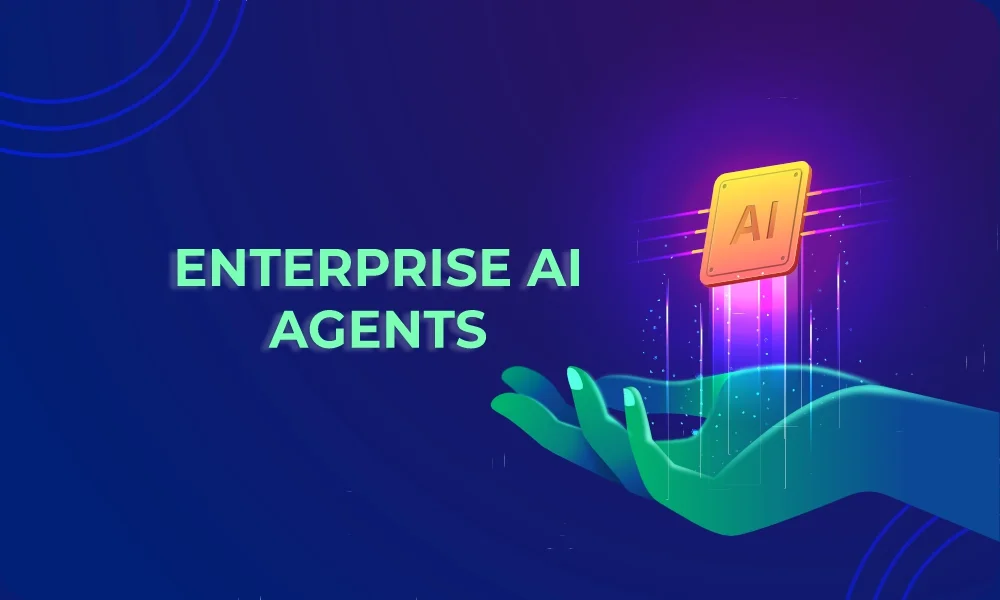
Enterprise AI agents are not chatbots with better prompts. They perceive inputs across multiple systems, reason about what to do next, execute sequences of actions using connected tools and APIs, and produce structured outputs – all without a human confirming each step.
Getting from a working demo to a production-grade system that runs reliably inside your security perimeter is an engineering problem, not a prompting problem. This guide explains what enterprise AI agent development services actually involve and how to make the build-vs-buy decision in 2026.
What Are Enterprise AI Agents?
An enterprise AI agent is an autonomous system that perceives structured and unstructured inputs, reasons about the appropriate action given current context and memory, executes that action using connected tools or APIs, monitors the result, and decides what to do next.
This loop repeats across multi-step workflows, often for hours or days, without a human approving each step.
That is structurally different from a chatbot. A chatbot receives a message and returns a response. An agent receives a trigger, checks its memory, queries your systems, executes a sequence of actions, handles exceptions, and produces a structured output ready for the next step downstream.
|
Dimension |
Chatbot |
Enterprise AI Agent |
| Input type | Single text message | Structured + unstructured data, events, API triggers |
| Execution model | Single-turn: in → out | Multi-step loop: perceive → plan → act → monitor → repeat |
| Memory | Typically stateless per session | Persistent context, task memory, retrievable history |
| System integration | None or one API connection | Multiple enterprise systems via tool calls |
| Compliance controls | Basic content filtering | Audit log, PII masking, role-based data access |
| Deployment options | Cloud SaaS default | Cloud, on-premise, air-gapped, or hybrid |
| Failure mode | Wrong answer | Wrong action that executes in a live system |
Gartner’s Agentic AI Hype Cycle 2025 identifies enterprise AI agents as the fastest-moving category in enterprise software investment. Gartner projects that by 2027, organizations with purpose-built enterprise agent infrastructure will outperform those using generic AI platforms by 3x on automation ROI.
The catch: most organizations significantly underestimate the production engineering requirements.
Real Enterprise Agent Use Cases That Are Running in Production
- BFSI: KYC document extraction and verification, AML transaction screening, loan application processing end to end
- Healthcare: Patient intake and triage routing, clinical documentation coding, prior authorization request handling
- Manufacturing: Purchase order processing, supplier onboarding, predictive maintenance work order generation
- Retail: Order exception handling, WISMO resolution, returns processing automation
- Legal: Contract review support, regulatory change monitoring, billing verification
5 Stages on How Enterprise AI Agent Development Actually Works
Custom enterprise AI agent development follows a defined engineering process. Each stage has specific outputs that determine whether the next stage is viable.
Skipping stages produces agents that work in a demo and break in production.
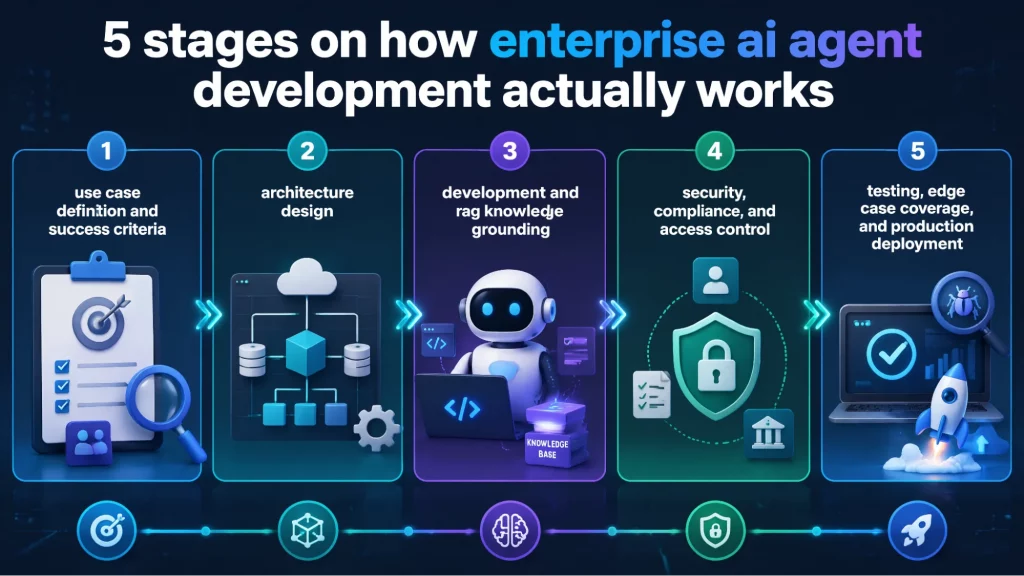
Stage 1: Use Case Definition and Success Criteria
Before any architecture is designed, the use case needs precise scope: which process, which systems, which data sources, and what ‘done’ means for each transaction. This stage produces a functional specification that defines the agent’s inputs, decision logic, action repertoire, output format, and measurable KPIs. Ambiguous specs produce agents that nobody agrees are working correctly.
Stage 2: Architecture Design
Architecture decisions here include LLM selection (which models, single vs. multi-LLM routing), tool integration design (which APIs and data sources the agent can access), memory model (session-scoped, persistent, or retrieval-augmented), and orchestration pattern (single agent, multi-agent pipeline, or hybrid).
These decisions have significant downstream cost, latency, and compliance implications.
Stage 3: Development and RAG Knowledge Grounding
This is where the agent is built. For agents that need to reason over enterprise knowledge – policies, procedures, product catalogs – a RAG layer is integrated here.
The agent connects to its tool ecosystem and knowledge sources. Core workflow logic gets implemented and tested at the unit level.
Stage 4: Security, Compliance, and Access Control
Production enterprise agents need a compliance layer that runs separately from the agent’s reasoning logic.
This includes PII detection and masking, role-based access controls on data sources, prompt injection defense, and an audit trail that logs every action, every retrieval, and every decision the agent makes. This stage is where most off-the-shelf platforms fall short for regulated industries.
Stage 5: Testing, Edge Case Coverage, and Production Deployment
Testing for enterprise agents goes well beyond unit tests. Edge case coverage, adversarial input testing, hallucination rate measurement across a representative sample of production transactions, and compliance scenario validation all need to pass before deployment.
Production deployment includes monitoring dashboards, alerting thresholds, rollback procedures, and a maintenance plan for model updates.
| AHT Tech builds custom enterprise AI agents with multi-LLM routing (GPT-4o, Claude, Gemini, Llama), on-premise deployment options, and compliance-first architecture for GDPR, HIPAA, SOC 2, and Vietnam AI Law 134/2025. |
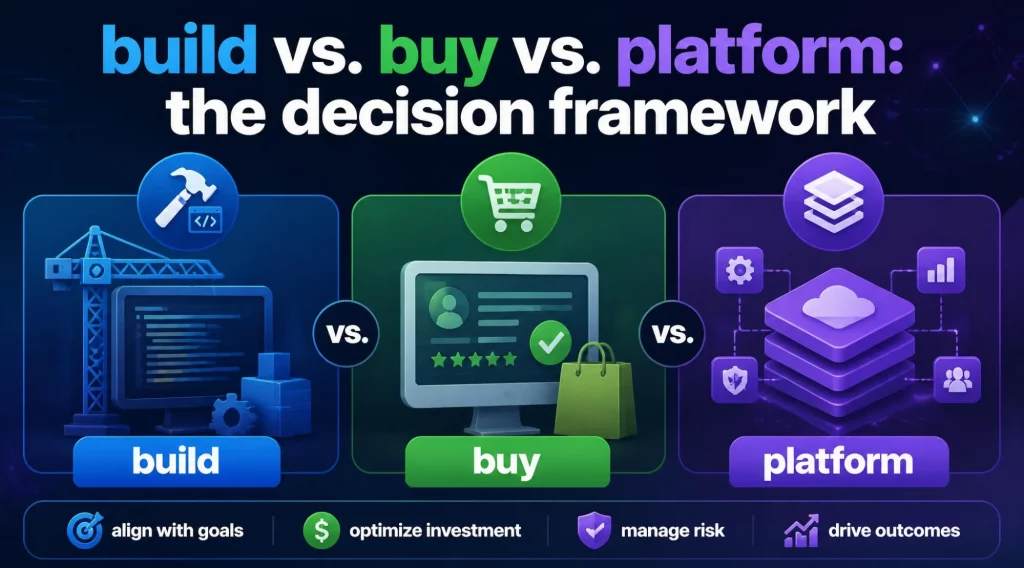
Build vs. Buy vs. Platform: The Decision Framework
The right approach depends on four variables: use case complexity, compliance requirements, integration depth, and timeline. Here is the honest breakdown.
|
Approach |
What You Get | Best For |
Main Risk |
| Off-the-shelf (Copilot Studio, Agentforce) | Pre-built templates, fast deployment in one ecosystem | Standard tasks in Microsoft or Salesforce stack | Ecosystem lock-in, limited compliance controls, no on-premise |
| No-code platform (AI Hive, similar) | 500+ templates, visual builder, multi-LLM routing, 30-min prototype | Mid-complexity use cases, fast time to first demo | Customization ceiling for complex integrations |
| Custom development (AHT Tech) | Full architecture, compliance layer, on-premise option, model-agnostic | Regulated industries, complex integrations, data sovereignty | Higher cost and timeline than platform approaches |
| Build in-house | Full control, no vendor dependency | Organizations with 10+ AI engineers and 12+ months of runway | $500k–$2M cost, 12–18 months before first production release |
For most mid-market and enterprise organizations, a combination approach works best: use pre-built templates for standard use cases, invest in custom development for your highest-value compliance-sensitive workflows. The platforms handle the 70% of common tasks; custom builds handle the 30% that actually differentiate your operation.
Compliance and Security: The Part Most Vendors Skip
Compliance is not an optional layer you bolt onto an enterprise AI agent after it works. It is part of the architecture from day one. This is especially true in BFSI, healthcare, and any industry operating under GDPR, HIPAA, SOC 2, or Vietnam’s AI Law 134/2025/QH15.
What On-Premise and Air-Gapped Deployment Actually Means
An on-premise AI agent deployment runs entirely within your private infrastructure. No data reaches an external LLM API. This is achieved by deploying a self-hosted LLM alongside your orchestration layer, inside your data center or private cloud.
Air-gapped deployment adds network isolation: no external connectivity at all. Both are technically achievable and are production-deployed today in banking and healthcare environments where data cannot leave the facility.
PII Handling and Audit Trail Architecture
Every agent that touches customer or patient data needs PII detection at the ingestion layer, not at output. Detection at output means the data was already processed by the LLM unmasked.
For HIPAA-covered data, the audit trail requirement is explicit: every system that accessed PHI needs to be logged with timestamp, user, and data accessed.
For GDPR, the right to explanation for automated decisions requires a trace from input to decision to output.
Both requirements need to be designed into the agent’s architecture before testing begins.
Multi-LLM Architecture: Why Single-Model Agents Are a Liability
Autonomous AI agents that route tasks to different LLMs based on task type outperform single-model architectures on cost and quality. Different models have measurable strengths in specific domains:
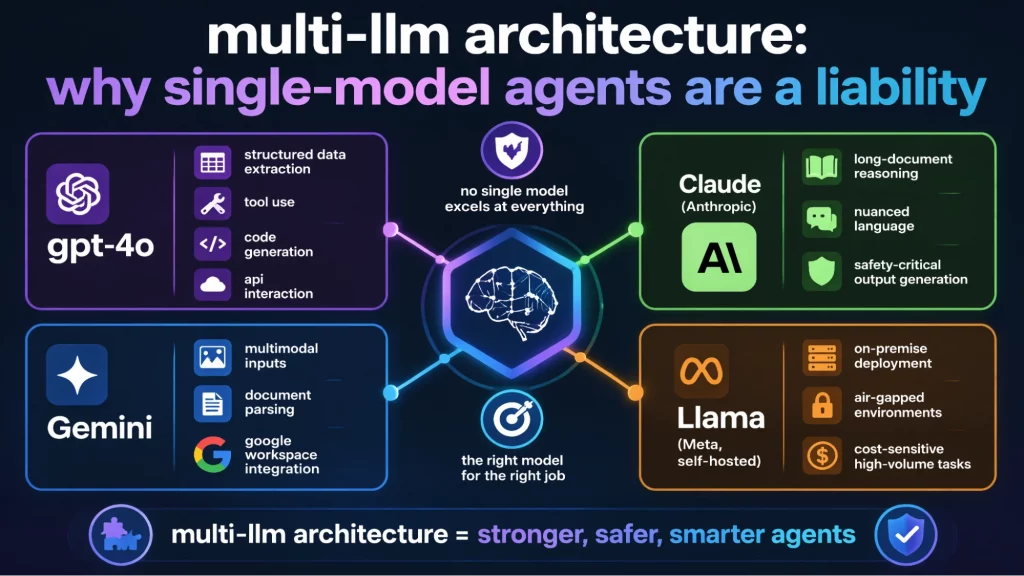
- GPT-4o: Structured data extraction, tool use, API interaction, code generation
- Claude (Anthropic): Long-document reasoning, nuanced language, safety-critical output generation
- Gemini: Multimodal inputs, document parsing, Google Workspace integration
- Llama (Meta, self-hosted): On-premise deployment, air-gapped environments, cost-sensitive high-volume tasks
Multi-LLM routing reduces API costs by 35–60% for enterprises with diverse agent workloads compared to sending all tasks to a single premium model.
The routing logic sits at the orchestration layer, selecting the model based on task type, token count, latency requirement, and compliance classification. Your agent’s business logic does not change.
What Enterprise AI Agent Development Costs: Real Ranges
|
Scope |
Typical Cost Range |
Typical Timeline |
| Single-agent, standard use case on no-code platform | $15,000 – $50,000 | 4–8 weeks |
| Custom single-agent, regulated industry | $80,000 – $200,000 | 8–16 weeks |
| Multi-agent orchestration system | $200,000 – $500,000+ | 4–9 months |
| In-house build with full engineering team | $500,000 – $2,000,000 | 12–18 months |
Building entirely in-house is not just expensive – it requires 5–10 AI engineers, ML infrastructure specialists, and compliance architects, most of whom are extremely difficult to hire.
McKinsey’s State of AI 2025 found that 68% of enterprise leaders cite talent scarcity as their primary barrier to AI agent deployment.
Outsourced development closes this gap without the hiring timeline or the overhead of maintaining a dedicated team for a single build.
Conclusion
Enterprise AI agent development is a distinct engineering discipline. It combines LLM reasoning, enterprise system integration, compliance architecture, and production reliability engineering. Getting from demo to production requires all four components to work together.
AHT Tech delivers end-to-end custom enterprise AI agent development services for regulated industries. Our approach covers architecture design, development, compliance layer build-out, testing, and production deployment – with multi-LLM routing via our AI Hive platform and on-premise options for environments where data cannot leave your infrastructure.
| Discuss your enterprise AI agent requirements with AHT Tech’s engineering team. Contact us to see service details and our delivery approach. |
FAQs
What is the difference between an AI agent and a chatbot?
A chatbot responds to single inputs with single outputs. An enterprise AI agent perceives multi-source inputs, reasons about a plan, executes multi-step actions using connected tools, and produces structured outputs – often without human intervention per step. Agents can run for minutes, hours, or days on complex tasks.
How long does enterprise AI agent development take?
A well-scoped single-agent project takes 8–16 weeks from architecture to production. Multi-agent orchestration systems take 4–9 months. Timeline is heavily influenced by compliance review cycles and integration complexity with legacy systems.
Can AI agents be deployed on-premise?
Yes. On-premise deployment uses a self-hosted LLM with a locally deployed orchestration layer and vector store. This is the required model for air-gapped environments in defense, certain banking environments, and healthcare organizations operating under HIPAA.
What LLMs are used in enterprise AI agents?
Enterprise agents typically route across multiple models depending on task type. GPT-4o, Claude, and Gemini cover cloud-hosted tasks. Llama and other open-source models cover on-premise and air-gapped deployments. A model-agnostic orchestration layer handles routing automatically.
What is multi-agent orchestration?
Multi-agent orchestration coordinates multiple specialized AI agents that work together on complex tasks. Each agent handles a specific sub-task – document extraction, compliance checking, decision logic, output formatting – and passes results to the next. This architecture scales better than single-agent systems for enterprise-wide automation.