


Choosing the Best IT Consulting Firms: Key Criteria and Expert Tips

TABLE OF CONTENT
What Are IT Consulting Firms?
Key Services Offered by Leading IT Consulting Firms
How to Choose the Right IT Consulting Firms
IT Consulting vs Management Consulting
Insider Experiences: What Clients Actually Wish They Knew Before Hiring IT Consulting Firms
Conclusion
Hiring the wrong IT consulting firm costs more than wasted budget. It can delay your digital transformation by months and leave your team managing a half-finished system. With hundreds of IT consulting firms competing for your project, the challenge is not finding options. It is knowing which criteria actually predict a successful partnership. This article walks through what these firms do, the services they offer, and how to choose the right partner for your business.
Key Takeaways
- Broad advisory scope: IT consulting firms provide strategic technology guidance across cloud migration, cybersecurity, ERP and CRM implementation, and AI and data analytics.
- Clear distinction: IT consulting differs from management consulting mainly in scope, since IT consulting focuses on technology systems while management consulting addresses broader business strategy and operations.
- Evaluation priorities: The strongest evaluation criteria include verifiable industry experience, technical certifications, and direct client references, not marketing claims alone.
- Pricing reality: Pricing varies widely by project scope and team seniority, so request a custom quote rather than comparing generic hourly rates across firms.
- Common failure point: Clients who have worked with IT consulting firms consistently point to unclear scope and poor communication cadence as the top reasons engagements underperform.
- AHT Tech’s role: Our IT consulting team has supported mid-market and enterprise clients across BFSI, healthcare, retail, manufacturing, and logistics for more than 19+ years.
What Are IT Consulting Firms?

IT consulting firms are professional services companies that advise businesses on using technology to solve specific operational problems or achieve strategic goals. Rather than building software on their own initiative, these firms assess your existing systems, recommend a technology direction, and often help implement that plan alongside your internal team.
Core services typically include digital transformation strategy, cloud migration and architecture, cybersecurity assessments, and AI or data analytics implementation. Some firms specialize narrowly, focusing only on cybersecurity or a single ERP platform, while others operate as full-service technology partners covering everything from infrastructure to custom software development.
IT consulting firms range widely in size and specialization. Global systems integrators serve the largest enterprise accounts with thousands of consultants across every technology domain. Boutique and mid-sized firms, by contrast, often specialize in a specific platform, industry, or region, which can translate into faster response times and more senior attention on smaller projects. Neither model is inherently better, but the right fit depends on your project’s scale, budget, and how much hands-on attention you expect from the team.
Businesses most commonly engage IT consulting firms during a specific trigger event, such as a planned cloud migration, a compliance deadline, a merger requiring system integration, or a legacy platform reaching end of vendor support.
Key Services Offered by Leading IT Consulting Firms
Most established IT consulting firms build their service portfolio around a similar core, though each firm packages it differently.
- Cloud migration and architecture: Moving on-premises infrastructure to platforms such as AWS, Microsoft Azure, or Google Cloud, then optimizing cost and performance on an ongoing basis.
- Cybersecurity consulting: Running risk assessments, compliance audits, and security architecture design to protect sensitive business and customer data.
- ERP and CRM implementation: Selecting, configuring, and integrating enterprise systems that unify finance, operations, and customer data.
- AI and data analytics: Building data pipelines, predictive models, and AI-powered automation that turn raw business data into decisions.
- Custom software and application development: Building bespoke tools or mobile applications when off-the-shelf software cannot meet a specific business requirement, often as a follow-on project once a consulting engagement uncovers a gap.
- Managed IT services: Providing ongoing infrastructure support, help desk coverage, and system monitoring, typically as a follow-on service once the initial consulting engagement ends.
Most firms structure engagements as one of three models: project-based work with a fixed scope and timeline, retainer-based advisory access billed monthly, or staff augmentation that embeds consultants directly into your team for a defined period. Understanding which model a firm defaults to helps you compare quotes accurately, since a project-based quote and a staff augmentation quote are not directly comparable.
Analysts increasingly note that IT consulting deliverables now blend strategic advice with hands-on implementation. Purely advisory engagements without execution support are becoming less common, since businesses want a partner who follows through rather than a report they have to implement themselves.
How to Choose the Right IT Consulting Firms
Many buyers start by searching for the top IT consulting firms or the best IT consulting firms in their industry, but published rankings rarely account for your specific technical requirements, company size, or budget.
Selecting an IT consulting firm involves more than comparing service lists, since most firms describe their capabilities in similar terms. Focus instead on the criteria that actually predict project success.
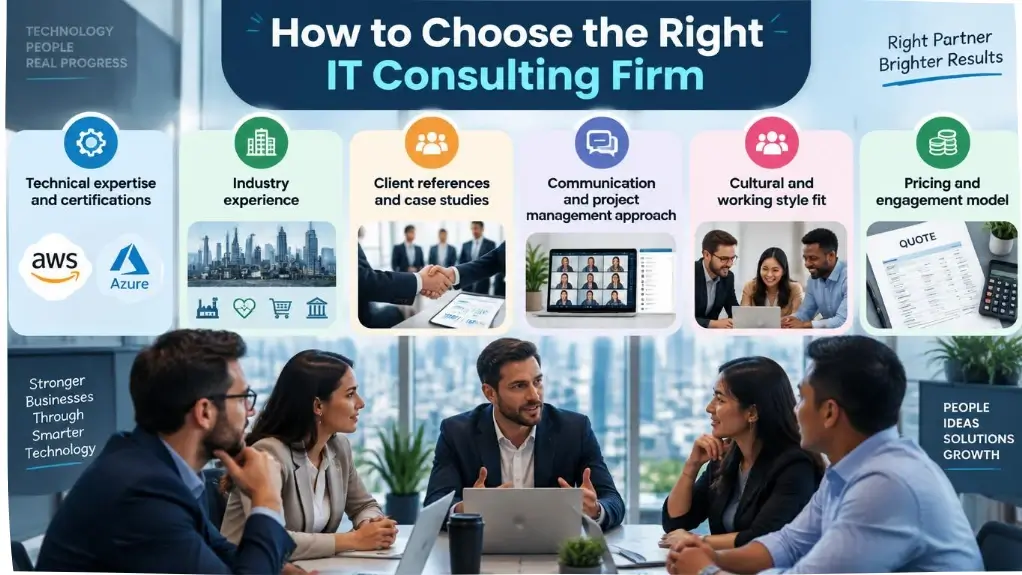
- Technical expertise and certifications: Verify that the firm holds current certifications relevant to your project, such as AWS or Azure partner status, rather than relying on general claims of expertise.
- Industry experience: A firm that has solved similar problems in your industry already understands your compliance requirements, common integration challenges, and typical project risks before the engagement even begins.
- Client references and case studies: Ask for references from clients with a similar company size and industry, then follow up with them directly rather than relying only on published testimonials.
- Communication and project management approach: Confirm how the firm structures check-ins, reporting, and escalation paths before you sign a contract, since unclear communication is one of the most common reasons engagements go off track.
- Cultural and working style fit: Confirm that the firm’s communication cadence, time zone overlap, and project management tools align with how your internal team already works, since a mismatch here creates friction even when the technical work is strong.
- Pricing and engagement model: Request a detailed, scoped quote from each shortlisted firm rather than comparing published rate cards, since pricing varies significantly by project scope, team seniority, and engagement length.
Rather than fixating on price during the shortlisting phase, prioritize the firms whose expertise and communication style best match your project’s complexity. The cheapest quote often costs more in the long run if it comes from a firm without the right industry experience.
IT Consulting vs Management Consulting
IT consulting firms and management consulting firms both advise businesses, but they focus on different problems and produce different deliverables.
|
Aspect |
IT Consulting | Management Consulting |
|---|---|---|
| Primary Focus | Technology systems and infrastructure | Business strategy and operations |
| Typical Deliverable | Cloud migration plan, security audit, configured system | Strategic recommendation, organizational redesign |
| Common Trigger | System upgrade, compliance deadline, merger integration | Market entry, restructuring, competitive strategy shift |
Consider a retailer planning to modernize its checkout systems. A management consulting firm might first assess whether the company’s broader growth strategy justifies the investment and how it affects staffing and store operations.
IT consulting firms then design and implement the actual point-of-sale and inventory integration, selecting the specific software and infrastructure needed to execute that strategy.
The two fields also differ somewhat in career structure and compensation, with large strategy-focused management consulting firms often commanding premium fees for senior partner-level engagements.
In practice, many technology initiatives sit at the intersection of both disciplines. A cloud migration project might start with a management consulting firm’s strategic review before IT consulting firms handle the technical execution, or a single firm may offer both capabilities under one roof.
Insider Experiences: What Clients Actually Wish They Knew Before Hiring IT Consulting Firms
In our experience working with clients across BFSI, healthcare, retail, and logistics, the businesses that regret an IT consulting engagement almost always point to the same handful of warning signs in hindsight.
Vague scope documents rank as the most common complaint. When a statement of work describes deliverables in broad terms such as improving system performance instead of specific, measurable outcomes, the engagement tends to run over budget and past deadline, because neither side has a clear definition of done.
Overreliance on junior staff after the sales process ends is another frequent pattern. Prospective clients often meet senior consultants during the pitch, only to have the day-to-day work handed to a more junior team once the contract is signed. Ask directly who will staff your project day-to-day, not just who leads the relationship.
Clients who have gone through multiple IT consulting engagements also flag contract flexibility as an underrated factor. Rigid, fixed-scope contracts that cannot accommodate a mid-project pivot often force businesses to either overpay for change orders or settle for a solution that no longer matches their actual needs by the time the project wraps up.
Red flags worth watching for include a firm that cannot provide references from your specific industry, pushback when you ask for a detailed statement of work, and pressure to sign before you have spoken with a proposed project lead.
On the positive side, engagements that go well typically share a firm that runs a structured discovery phase before quoting a fixed scope, assigns a named project lead who stays consistent throughout the engagement, and reports measurable milestones on a regular cadence rather than only at project completion.
AHT Tech’s IT consulting services follow this structure for every engagement, starting with a scoped discovery phase before committing to a fixed timeline and deliverable list.
Conclusion
Choosing the right IT consulting firms comes down to matching proven expertise and clear communication to your project’s complexity, not chasing the lowest quote or the biggest brand name. Use the criteria in this guide to shortlist firms, verify references directly, and insist on a detailed, scoped proposal before signing anything.
If you want a partner with 19+ years of enterprise delivery experience, contact our IT consulting team to discuss your project.
FAQs
What do IT consulting firms actually do?
IT consulting firms assess your existing technology systems, recommend improvements aligned with your business goals, and often help implement those changes, covering areas such as cloud migration, cybersecurity, ERP implementation, and custom software development.
How much does IT consulting cost?
IT consulting costs vary significantly based on project scope, team seniority, and engagement length, so there is no standard rate that applies across firms. Rather than comparing hourly rates, request a detailed, scoped quote from each firm you shortlist so you can compare like-for-like proposals.
What is the difference between IT consulting and IT services?
IT consulting focuses on strategic advice, such as recommending which technology to adopt and how to implement it, while IT services typically refers to the ongoing, hands-on delivery of a working system, such as managed IT support or help desk operations.
How long does an IT consulting engagement typically take?
Engagement length depends heavily on scope. A focused cybersecurity audit might take four to six weeks, while a full digital transformation initiative involving multiple systems can run six months or longer.
What red flags should I watch for when hiring IT consulting firms?
Watch for vague scope documents, reluctance to provide industry-specific references, and pressure to sign a contract before you have met the actual project team who will do the day-to-day work.