




Multi-Cloud vs. Single-Cloud Strategy: Which Is Better for Scalability?

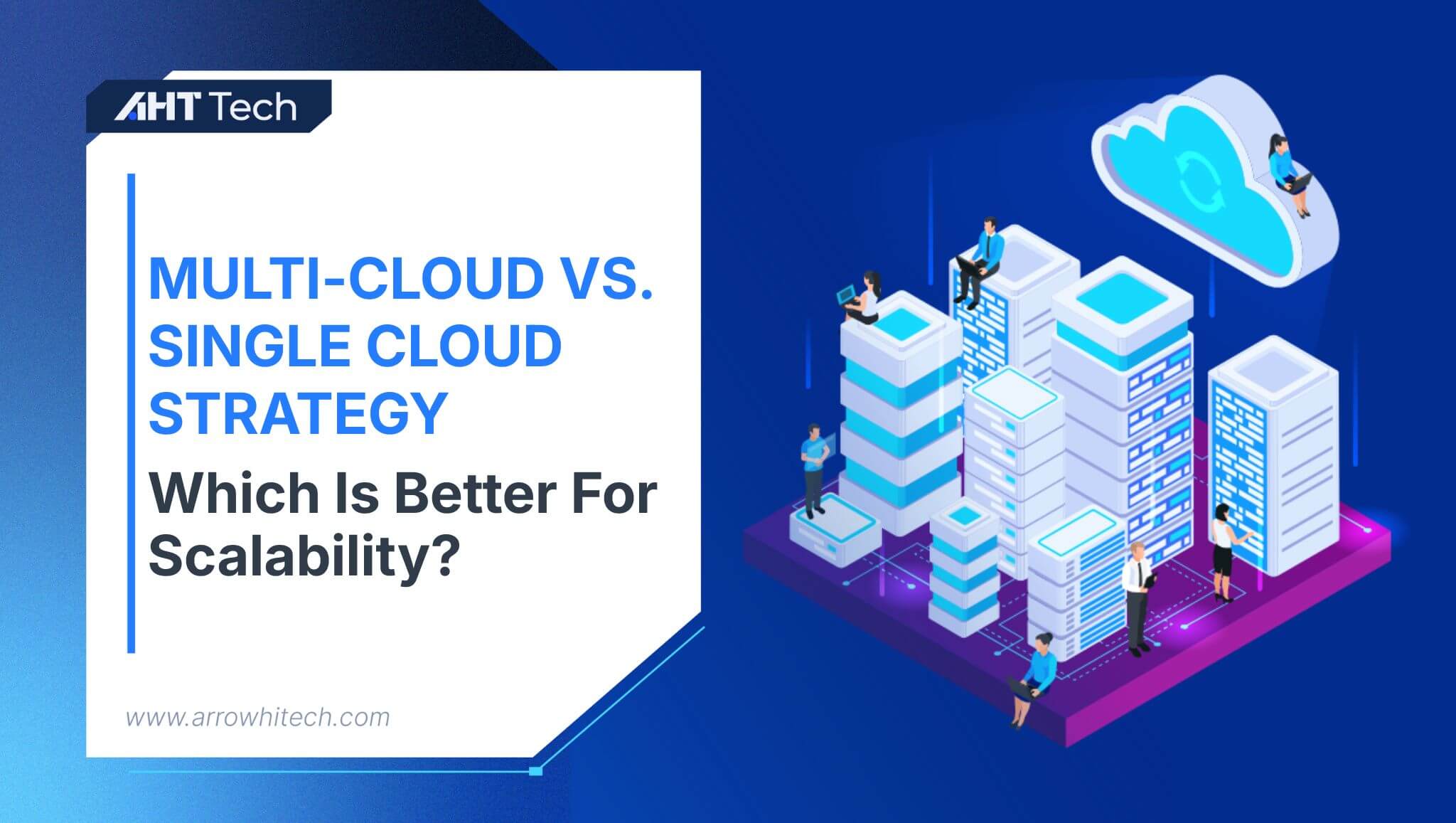
TABLE OF CONTENT
What is a single-cloud strategy?
What is a multi-cloud strategy?
Multi-cloud vs. single-cloud: Quick comparison
What does scalability actually mean for cloud services?
Which strategy provides better scalability?
Multi-cloud vs. single-cloud cost comparison
How a cloud services partner can support scalable cloud architecture
Conclusion
Cloud adoption is no longer simply about moving workloads away from on-premise infrastructure. For many businesses, the bigger question is how to build a cloud environment that can continue scaling as application demand, data volumes, AI workloads, geographic reach, and operational requirements grow.
A single-cloud strategy allows organizations to concentrate their applications and infrastructure within one cloud ecosystem, potentially simplifying management, security, skills development, and cost control. Multi-cloud, on the other hand, enables businesses to use cloud services from multiple providers, potentially increasing workload flexibility, geographic coverage, technology choice, and resilience.
But using more cloud providers does not automatically create a more scalable environment.
The better question is:
Which cloud strategy enables the business to scale performance, operations, security, and cost without introducing unnecessary complexity?
Flexera’s 2026 State of the Cloud Report found that 73% of surveyed organizations now operate hybrid cloud estates, while estimated wasted cloud spend has risen to 29%. These numbers indicate that enterprises are expanding their cloud footprints, but many are also struggling to manage the financial and operational consequences of that expansion.
This article compares multi-cloud vs single-cloud strategies from a scalability perspective and explores how businesses can determine which approach is better suited to their long-term cloud requirements.
What is a single-cloud strategy?
A single-cloud strategy means an organization relies primarily on one public cloud provider for its infrastructure, applications, databases, storage, networking, analytics, and other cloud services.
A single-cloud environment can provide several operational advantages:
- One primary cloud management framework
- Centralized identity and access management
- More consistent security policies
- Fewer infrastructure tools
- Consolidated cloud billing
- A more focused internal cloud skill set
- Deeper integration with provider-native services
A software company, for example, may choose AWS for compute, managed databases, storage, container orchestration, monitoring, and disaster recovery rather than distributing those workloads across several platforms.
The organization can then focus its engineering resources on optimizing one architecture instead of maintaining expertise across several environments.
What is a multi-cloud strategy?
A multi-cloud strategy uses cloud services from two or more cloud providers.
A company might use:
- AWS for customer-facing applications
- Microsoft Azure for enterprise systems integrated with Microsoft technologies
- Google Cloud for data analytics and machine learning
- A regional cloud provider for specific regulatory or data residency requirements
However, multi-cloud does not mean every application must run simultaneously across multiple clouds.
In practice, many organizations use a workload-based approach. Applications are placed on different providers depending on requirements such as performance, geographic availability, data services, AI capabilities, cost, or regulatory constraints.
Some companies deliberately design this architecture. Others become multi-cloud organizations gradually through mergers, acquisitions, independent development teams, or different business units choosing different platforms.
A well-designed multi-cloud environment can provide flexibility. An uncontrolled collection of cloud platforms can instead become a source of technical debt.
Multi-cloud vs. single-cloud: Quick comparison
|
Consideration |
Single-cloud |
Multi-cloud |
| Operational complexity |
Lower |
Higher |
| Initial implementation effort |
Lower |
Higher |
| Workload flexibility |
Moderate |
High |
| Vendor concentration |
Higher |
Lower |
| Cloud skills required |
More focused |
Broader |
| Billing visibility |
Easier to consolidate |
More complex |
| Geographic flexibility |
Depends on provider |
Potentially broader |
| Access to specialized services |
One ecosystem |
Multiple ecosystems |
| Cross-cloud resilience |
Limited |
Possible |
| Networking complexity |
Lower |
Higher |
| Governance requirements |
Moderate |
High |
| Scalability potential |
High |
High when properly managed |
The key distinction is that single-cloud often makes scalability simpler, while multi-cloud can make scalability more flexible.
What does scalability actually mean for cloud services?
Cloud scalability is often discussed as if it simply means increasing compute or storage capacity. A scalable cloud strategy needs to support several dimensions of growth.
1. Compute scalability
Infrastructure should respond to increasing application demand without requiring constant manual provisioning.
This can involve:
- Autoscaling virtual machines
- Containers
- Kubernetes clusters
- Serverless computing
- Elastic databases
- Distributed application architecture
2. Data scalability
Applications increasingly process large volumes of transactional, customer, IoT, analytics, and AI-related data.
Cloud architecture therefore needs to scale databases, data lakes, storage, backup, and processing platforms alongside application demand.
3. Geographic scalability
A company expanding from one country to several markets may need additional cloud regions to maintain application performance, meet data residency requirements, and support disaster recovery.
4. Application scalability
A scalable environment needs to support not only more users but also more applications, APIs, services, integrations, and development teams.
5. Organizational scalability
This aspect is often overlooked.
If adding another cloud environment requires significantly more manual work, security controls, deployment pipelines, and specialist engineers, infrastructure may scale technically while the IT organization struggles to keep up.
6. Financial scalability
Infrastructure also needs to remain economically sustainable.
If cloud costs increase faster than business growth, the architecture may technically scale but still become commercially difficult to sustain.
This is particularly relevant in 2026. Flexera reports that estimated wasted IaaS and PaaS cloud spend increased to 29%, following several years of decline. Growing AI workloads, increasingly diverse pricing models, and the expansion of cloud services are contributing to greater cost-management difficulty.
Which strategy provides better scalability?
Single-cloud can offer better operational scalability
For many organizations, single-cloud provides a simpler path to scaling because infrastructure remains within one operating model.
Teams can work with:
- One identity framework
- One primary observability ecosystem
- One billing model
- One network architecture
- One cloud governance framework
- A smaller range of infrastructure skills
This can make it easier to add applications, teams, and infrastructure without multiplying operational processes.
Cloud-native services also tend to integrate closely within the same provider ecosystem, potentially reducing engineering effort.
Multi-cloud can provide greater architectural flexibility
Multi-cloud becomes more attractive when different workloads have significantly different requirements.
An organization might want to select providers according to:
- Geographic availability
- GPU capacity
- AI services
- Data platforms
- Regulatory considerations
- Enterprise software integrations
- Disaster recovery requirements
- Pricing characteristics
The organization gains more infrastructure choices rather than being constrained to the capabilities and regions of one provider.
However, this flexibility comes with an important trade-off: The technically most scalable architecture is not always the operationally most scalable architecture.
If a business cannot consistently manage security, networking, deployments, monitoring, and costs across providers, adding more cloud environments may reduce agility rather than improve it.
Six reasons businesses adopt multi-cloud services
There are several situations where adopting cloud services from multiple providers can support business growth.
1. Matching workloads to the right cloud environment
Different providers may offer different strengths across databases, analytics, AI, enterprise integrations, networking, or application development.
Multi-cloud allows organizations to choose infrastructure based on workload requirements rather than placing every application on the same platform.
For example, an enterprise could maintain Microsoft-centric business applications within Azure while using another provider for specific data or AI workloads.
2. Reducing strategic dependency on one provider
Using several providers can reduce the organization’s overall dependence on a single cloud vendor.
This can improve procurement flexibility and reduce concentration risk.
However, multi-cloud should not be confused with complete application portability.
Applications that rely heavily on proprietary databases, serverless frameworks, AI APIs, or managed services can still be difficult and expensive to move between providers.
3. Supporting geographic expansion
Businesses operating internationally may require infrastructure in regions that are not equally well supported by every provider.
Multi-cloud can expand available geographic options and help organizations place applications closer to customers or business operations.
4. Accessing specialized AI, analytics, and data services
AI infrastructure is making workload placement increasingly important.
Organizations may choose different providers based on:
- GPU availability
- Foundation model ecosystems
- Machine learning platforms
- Data warehouses
- AI development tools
- Specialized computing infrastructure
Flexera reported in 2026 that 81% of surveyed organizations were already using generative AI, up from 72% in the prior year’s survey. As AI moves from experimentation to production, infrastructure requirements can become significantly more demanding.
5. Addressing regulatory and sovereignty requirements
Data residency and digital sovereignty are becoming more important parts of cloud architecture.
Gartner predicted that more than 50% of multinational organizations will have digital sovereignty strategies by 2029, compared with less than 10% when the forecast was published.
For international businesses, this may influence which providers, regions, or local cloud environments can host certain applications and datasets.
6. Supporting resilience strategies
Multi-cloud can form part of a broader business continuity strategy.
Critical applications can potentially be designed to operate across providers or recover within a secondary environment.
However, simply having accounts with two cloud providers does not create resilience.
Effective multi-cloud disaster recovery requires planning for:
- Data replication
- Network failover
- Application dependencies
- DNS
- Identity services
- Observability
- Infrastructure provisioning
- Recovery procedures
Without this architecture, a second provider may add complexity without materially improving availability.
When a single-cloud strategy may be better
Multi-cloud receives considerable attention, but many organizations do not need it.
Single-cloud can remain an effective strategy when one provider already meets the majority of business and technical requirements.
It may be particularly suitable when:
- The organization is early in its cloud transformation.
- Most workloads have similar infrastructure requirements.
- The business operates primarily within regions supported by one provider.
- Internal DevOps and cloud engineering resources are limited.
- Simplifying cloud governance is a priority.
- Applications benefit substantially from provider-native services.
- Cross-cloud portability provides little measurable business value.
Consider a mid-sized eCommerce business primarily serving customers in one market.
If its selected cloud provider already delivers sufficient computing capacity, managed databases, security, CDN, disaster recovery, and local infrastructure, introducing two additional providers may not improve scalability.
Instead, additional cloud environments could create new costs and skills requirements. Cloud strategy should follow business requirements, not infrastructure trends.
When multi-cloud makes more business sense
Multi-cloud is more compelling when organizations can clearly identify requirements that cannot be addressed efficiently within one environment.
Typical triggers include:
- International operations across many regions
- Different regulatory or data residency requirements
- Large-scale AI workloads
- Acquisitions involving different cloud environments
- Specialized analytics requirements
- Business-critical availability requirements
- Significant vendor concentration risk
- Highly distributed engineering organizations
- Existing applications already deployed across different clouds
Adding a second provider should solve a specific business or technical problem.
If an organization cannot explain why a workload needs another cloud, the additional architecture may not deliver enough value to justify the operational overhead.
Multi-cloud vs. single-cloud cost comparison
Cost is another area where the more complex architecture is not necessarily cheaper.
|
Cost area |
Single-cloud |
Multi-cloud |
| Infrastructure usage | Based on provider consumption | Based on multiple providers |
| Data transfer | Usually simpler | Cross-cloud egress may increase cost |
| Engineering | More concentrated skills | Broader expertise required |
| Monitoring | Provider-native tools may suffice | Unified observability often needed |
| Security | Fewer platforms | More policy integrations |
| Training | Focused | Broader |
| FinOps | Important | Increasingly critical |
| Commitment discounts | Easier to consolidate | Spend distributed between vendors |
| Governance | More centralized | Additional coordination required |
Flexera’s 2026 research estimated that 29% of cloud spend is wasted, while cost optimization remains a major focus across enterprise cloud strategies.
How to choose between multi-cloud and single-cloud
The decision should begin with workloads rather than cloud providers. Use the following framework.
1. Assess workload requirements
Classify applications according to:
- Performance
- Availability
- Security
- Compliance
- Data residency
- Growth expectations
- Data dependencies
- Disaster recovery requirements
Avoid selecting providers before these requirements are clear.
2. Identify where one provider creates real limitations
Ask whether the existing cloud environment is actually preventing the business from scaling.
For example:
- Is a required region unavailable?
- Are AI resources constrained?
- Are specific regulatory requirements difficult to meet?
- Are certain enterprise integrations stronger elsewhere?
- Is vendor concentration creating material risk?
If there is no meaningful limitation, adding another provider may not be necessary.
3. Calculate total cost of ownership
Cloud TCO should extend beyond monthly infrastructure invoices.
Include:
- Compute and storage
- Network egress
- Security tooling
- Monitoring
- Cloud management platforms
- Engineering resources
- Support contracts
- Training
- Migration effort
- Ongoing operations
A multi-cloud environment that reduces infrastructure pricing but substantially increases engineering overhead may not actually reduce total cost.
4. Evaluate your operational maturity
Multi-cloud becomes easier to manage when organizations already have mature capabilities in:
- Infrastructure as code
- DevOps
- Platform engineering
- Identity governance
- Cloud security
- Observability
- FinOps
- Automated policy enforcement
Without these foundations, complexity can scale faster than infrastructure.
5. Define a workload-placement strategy
For every workload, teams should be able to explain:
- Why it runs on a particular provider
- Which data it depends on
- How it is secured
- How costs are tracked
- How it is monitored
- How it will recover from failure
This changes multi-cloud from an infrastructure collection into an intentional architecture.
How a cloud services partner can support scalable cloud architecture
Businesses must evaluate application architecture, security, networking, migration dependencies, cloud economics, observability, data management, and long-term operations.
An experienced cloud services partner can help organizations assess these requirements before committing to unnecessary infrastructure complexity.
Typical capabilities may include:
- Cloud readiness assessments
- Cloud architecture consulting
- Multi-cloud strategy
- Cloud migration services
- Application modernization
- Cloud-native development
- DevOps and infrastructure automation
- Cloud security
- FinOps and cloud cost optimization
- Monitoring and observability
- Managed cloud services
- Backup and disaster recovery
For organizations already using several providers, the priority may be standardization and governance rather than adding more cloud platforms.
For organizations operating primarily in one cloud, the first step may instead be identifying whether current limitations are architectural, operational, or genuinely provider-related.
Either way, the goal is the same: build cloud infrastructure that can grow without allowing cost and complexity to grow uncontrollably with it.
AHT Tech helps businesses turn cloud strategy into an architecture that fits their actual growth needs with our Cloud Services. Rather than adding more cloud platforms by default, we work with organizations to evaluate workload requirements, existing infrastructure, scalability priorities, and operational constraints before defining the right cloud approach.
This helps businesses make more informed decisions between single-cloud, multi-cloud, or hybrid environments while maintaining greater control over performance, cost, and complexity as they scale.
Contact us to discuss further!
Conclusion
A sustainable cloud strategy must allow applications, data, teams, security processes, and budgets to scale together. Whether that means remaining with one provider, adopting multiple cloud platforms, or building a broader hybrid architecture depends on the business problem being solved.
If your organization is evaluating cloud migration, modernization, multi-cloud architecture, or infrastructure optimization, a structured cloud assessment can help identify where additional cloud services create measurable value, and where greater simplicity may be the more scalable choice.
Ready to evaluate your cloud architecture? Talk with our cloud services specialists to assess your workloads, scalability requirements, security, cloud costs, and long-term infrastructure roadmap.
FAQs
Is multi-cloud more scalable than single-cloud?
Not automatically. Multi-cloud provides more workload-placement options and can increase geographic or technology flexibility. Single-cloud often provides simpler operational scalability because infrastructure, governance, monitoring, and skills remain within one ecosystem. The best model depends on business and workload requirements.
What are the main benefits of multi-cloud services?
Common benefits include access to specialized cloud technologies, broader geographic coverage, vendor diversification, workload flexibility, regulatory options, and potential improvements in resilience.
What are the disadvantages of multi-cloud?
Multi-cloud can increase networking complexity, security requirements, cloud management overhead, skills requirements, monitoring challenges, and cost-management difficulty. Businesses therefore need strong governance and automation before expanding across multiple providers.
Can a single-cloud environment support enterprise scalability?
Yes. Major public cloud platforms provide extensive compute, networking, storage, database, container, AI, autoscaling, and global infrastructure capabilities. Many organizations can scale effectively within one cloud when the provider meets their geographic, compliance, application, and resilience requirements.
Does multi-cloud eliminate vendor lock-in?
No. It can reduce overall organizational dependence on one provider, but individual applications may still depend heavily on proprietary databases, APIs, serverless services, analytics tools, or AI platforms. Application architecture and portability need to be evaluated separately.
How should businesses choose cloud services?
Start with workload requirements. Evaluate performance, availability, security, regulatory requirements, data location, integrations, cloud costs, internal skills, future growth, and operational maturity before selecting a provider or architecture.