


AI & Predictive Analytics: The Next Frontier for Supply Chain Software Development Services

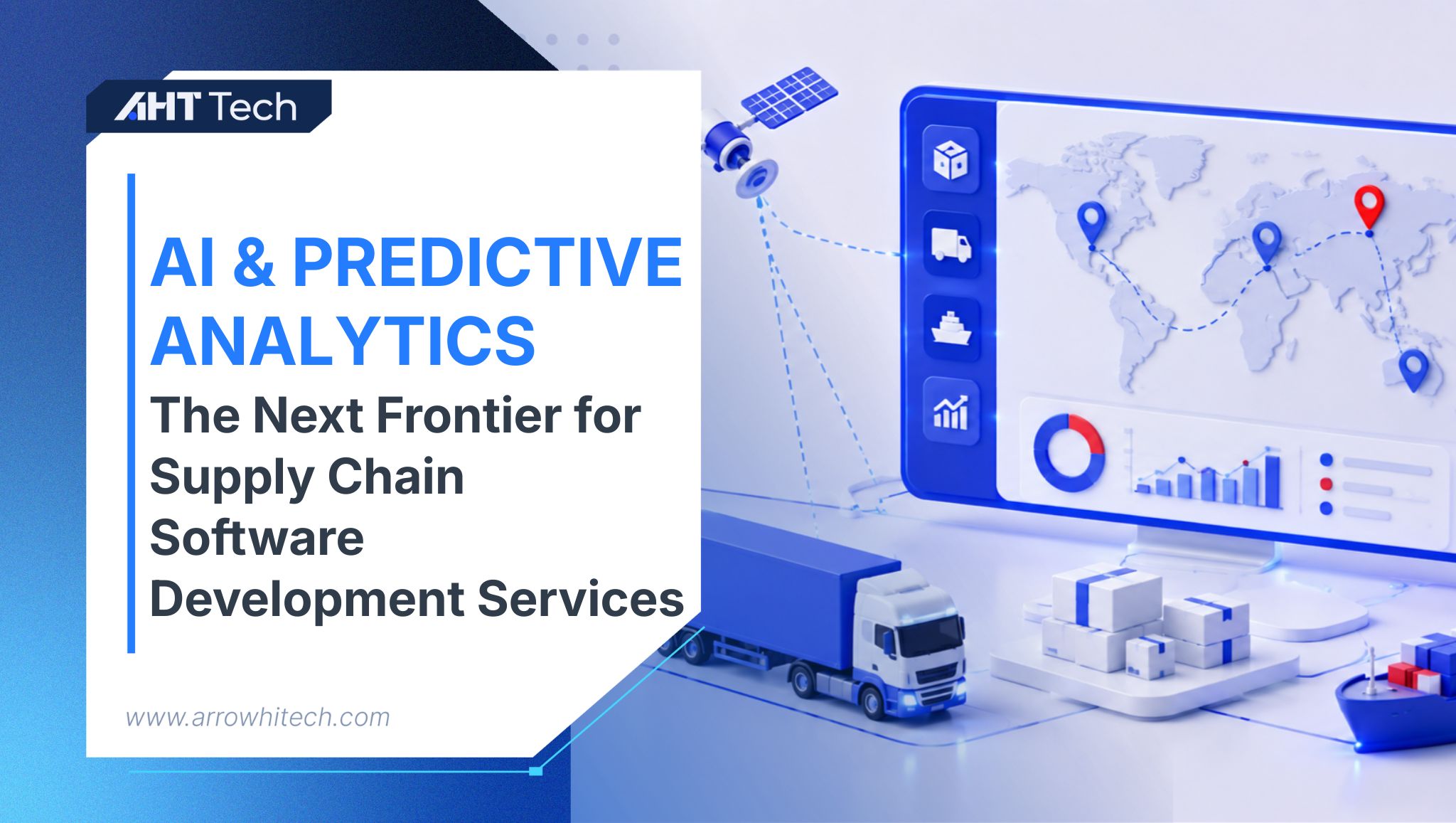
TABLE OF CONTENT
Why Supply Chain Software Development Services Are Entering an AI-First Era
What AI Adds to Traditional Supply Chain Software
High-Impact AI and Predictive Analytics Use Cases
From Predictive AI to Agentic Supply Chains
Why Custom Supply Chain Software Development Still Matters
Conclusion
Supply chains are becoming too complex, volatile, and interconnected for traditional software to manage through historical reporting alone. Businesses now need systems capable of anticipating demand, identifying risks, recommending actions, and increasingly executing decisions automatically. This shift is redefining supply chain software development services, moving them beyond workflow digitization toward AI-powered decision intelligence.
From demand sensing and inventory optimization to disruption management and intelligent logistics, artificial intelligence and predictive analytics are quickly becoming part of the core architecture of modern supply chain platforms.
And from 2026 onward, this transition is expected to accelerate significantly.
Why Supply Chain Software Development Services Are Entering an AI-First Era
For years, supply chain systems primarily answered one question:
What has already happened?
ERP, warehouse management, transportation management, procurement, and business intelligence platforms collected transactions and transformed them into reports.
The next generation of supply chain technology must answer more difficult questions:
- What is likely to happen next?
- Where will demand increase or decrease?
- Which supplier is most likely to miss a delivery?
- Which inventory position creates a stockout risk?
- How will weather, tariffs, transportation capacity, or geopolitical events affect fulfilment?
- What action should the business take now?
This is where predictive analytics in supply chain operations becomes particularly valuable.
Rather than waiting for exceptions to appear in a dashboard, predictive systems combine historical records, live operational data, external signals, machine learning models, and optimization engines to identify probable outcomes before they affect operations.
The market is already moving rapidly in this direction.
|
Market Indicator |
2026 |
Future Forecast |
| Global AI in supply chain market | USD 13.9B | USD 51.1B by 2030 |
| Global predictive analytics market | USD 30.1B | USD 82.3B by 2030 |
| SCM software with agentic AI | Rapid emerging adoption | USD 53B spending by 2030 |
| Enterprises using SCM software with agentic AI | Early-stage adoption | 60% by 2030 |
Grand View Research expects the AI-in-supply-chain market to expand from approximately USD 13.9 billion in 2026 to USD 51.1 billion by 2030, representing a 38.9% CAGR over its forecast period. Its broader predictive analytics forecast estimates a rise from USD 30.1 billion in 2026 to USD 82.3 billion by 2030.
Gartner points to an even more significant change at the software layer. Spending on supply chain management software containing agentic AI capabilities is forecast to grow from less than USD 2 billion in 2025 to USD 53 billion by 2030, while adoption among enterprises using SCM software could increase from around 5% in 2025 to 60% by 2030.
These forecasts measure different technology categories and should not be treated as directly comparable market sizes. Together, however, they point to the same strategic direction: intelligence is becoming a fundamental layer of supply chain software.
What AI Adds to Traditional Supply Chain Software
AI does not replace conventional ERP, WMS, TMS, or SCM platforms. Instead, it adds an intelligence layer across the existing technology ecosystem.
Consider 04 levels of supply chain analytics:
|
Level |
Business Question |
Example |
| Descriptive | What happened? | Inventory fell below safety stock |
| Diagnostic | Why did it happen? | Demand increased while supplier lead time slipped |
| Predictive | What will happen next? | Stockout probability reaches 78% within 12 days |
| Prescriptive | What should we do? | Reallocate inventory and accelerate the next PO |
The emerging fifth layer is agentic execution.
Instead of simply recommending an action, an AI agent could evaluate inventory, identify alternative suppliers, calculate cost implications, prepare a purchase order, and route it for human approval.
This transition from analytics to action explains why modern AI supply chain solutions require more than adding an AI chatbot to existing applications.
They need tightly integrated data, models, business rules, workflows, APIs, security controls, and human oversight.
High-Impact AI and Predictive Analytics Use Cases
1. Demand Forecasting and Demand Sensing
Demand forecasting remains one of the strongest use cases for machine learning.
Traditional forecasts frequently depend heavily on historical averages. AI models can incorporate far more variables, including:
- Historical sales
- Seasonality
- Promotions
- Pricing changes
- Regional patterns
- Weather
- Holidays
- Customer behaviour
- Marketplace trends
- Macroeconomic signals
The result is not merely a monthly sales estimate but potentially SKU-, store-, region-, and time-specific demand predictions.
Amazon, for example, has developed AI forecasting models that predict what customers are likely to need, where they will need it, and when. The company reported in 2025 that enhanced AI demand forecasting improved its regional forecast accuracy by 20%, supporting better inventory placement and delivery performance.
2. Intelligent Inventory Optimization
Forecasting demand is useful only if businesses can convert that information into inventory decisions.
Predictive inventory systems can continuously calculate:
Expected Demand → Available Stock → Supplier Lead Time → Safety Stock → Replenishment Recommendation
Instead of maintaining static reorder points, algorithms can adjust inventory policies based on changing conditions.
For multi-location retailers, distributors, and manufacturers, this becomes especially powerful because the software can determine not only how much inventory is required, but also where inventory should be positioned.
In 2026, Amazon expanded access to its Supply Chain Services, highlighting AI forecasting and supply chain data as capabilities used to optimize inventory placement across distribution and fulfilment networks.
3. Disruption and Supply Chain Risk Prediction
Modern supply chains face constant external risk:
- Port congestion.
- Supplier failures.
- Extreme weather.
- Geopolitical conflict.
- Transportation delays.
- Raw material shortages.
Traditional systems often detect these problems after milestones are missed. AI-supported platforms can instead combine internal orders with external signals to calculate disruption probability.
The software may detect that a shipment is likely to arrive five days late, identify the customer orders affected, simulate alternative inventory allocation, and recommend an alternative transportation route before the delay becomes critical.
Walmart provides a current example. Its supply chain systems integrate real-time weather intelligence with operational infrastructure to model severe-weather scenarios and support decisions involving inventory, transportation, and fulfilment before disruption occurs.
Gartner expects this capability to evolve much further, predicting that by 2031, 60% of supply chain disruptions could be resolved without human intervention as increasingly autonomous supply chains combine real-time analytics with AI-driven execution.
4. Smarter Transportation and Fulfilment Decisions
An order can potentially be fulfilled from a warehouse, distribution centre, store, supplier, or third-party logistics partner.
Determining the optimal node requires balancing:
- Inventory availability
- Transportation cost
- Delivery SLA
- Warehouse workload
- Driver capacity
- Order consolidation opportunities
- Distance
- Customer priority
AI can evaluate these variables in real time.
Walmart’s Fulfillment Engine, for example, combines predictive inventory positioning with AI agents and real-time decision intelligence to select the most appropriate fulfilment location. Its systems analyse signals including demand, weather, store activity, logistics constraints, driver capacity, and delivery promises.
For enterprises building custom platforms, similar decision engines can sit between OMS, WMS, TMS, ERP, and eCommerce systems.
5. Predictive Procurement and Supplier Management
Procurement systems are also moving from transaction processing toward predictive decision support.
Imagine a system detecting that a critical component faces a high shortage probability within the next six weeks.
Instead of simply sending an alert, the platform could:
- Identify affected production orders.
- Calculate available alternative inventory.
- Compare approved suppliers.
- Evaluate lead times and price changes.
- Recommend an alternative sourcing strategy.
- Generate an approval request.
Amazon Business and Deloitte announced an AI-powered industrial manufacturing solution scheduled for rollout in 2026 that uses AI agents to identify potential parts and inventory disruptions and recommend actions such as reallocating stock or expediting compatible parts.
This illustrates how predictive analytics is gradually merging with workflow automation.
From Predictive AI to Agentic Supply Chains
Predictive analytics tells organizations what is likely to happen. Generative AI makes supply chain information easier to interact with.
Agentic AI introduces the ability to take or coordinate actions.
A future supply chain control tower might work like this:
Data Sources
ERP + WMS + TMS + IoT + Supplier Data + External Signals
↓
Prediction Layer
Demand Forecasting + ETA Prediction + Risk Scoring + Inventory Models
↓
Decision Layer
Optimization + Scenario Simulation + Business Rules
↓
AI Agent Layer
Investigate → Recommend → Trigger Workflow → Monitor Outcome
↓
Human Governance
Approve high-risk or high-value decisions
DHL is already exploring this combination, using generative AI for predictive demand, shipping intelligence, customer onboarding, customs processes, and procurement-related workflows.
Gartner consequently lists agentic AI and physical AI among the leading supply chain technology trends for 2026, reflecting a broader transition toward more autonomous and adaptive systems.
Why Custom Supply Chain Software Development Still Matters
The increasing availability of AI-enabled SaaS platforms does not eliminate the need for custom supply chain software development.
Enterprise supply chains rarely run on a single standardized technology stack.
A manufacturer may simultaneously use:
- SAP or Oracle for ERP
- A specialist WMS
- Custom production systems
- Supplier portals
- EDI
- IoT sensors
- Third-party logistics platforms
- Excel-based planning models
- Power BI
- Legacy databases
AI cannot generate reliable predictions when the underlying operational context is fragmented.
This is where supply chain software development services increasingly focus on integration and intelligence rather than building isolated applications.
Development teams may need to create:
- Data integration layers connecting ERP, WMS, TMS, CRM, supplier, IoT, and external sources.
- Machine learning pipelines for training, validating, and monitoring forecasting models.
- Decision engines combining predictions with business rules and optimization algorithms.
- Operational dashboards showing alerts, scenarios, risk scores, and recommended actions.
- Workflow automation converting insights into approvals, procurement, inventory transfers, or transportation decisions.
- AI agents capable of performing multi-step operational tasks within defined guardrails.
The quality of the AI therefore depends heavily on the quality of the software architecture around it.
A Practical Roadmap for Implementing Predictive Supply Chain Software
Despite rapid market growth, enterprises should avoid attempting full supply chain autonomy immediately.
Gartner surveyed senior supply chain leaders in late 2025 and found that only 17% were pursuing immediate transformational process redesign, while 83% were applying AI incrementally to individual use cases or gradually expanding it across integrated processes. Data readiness, talent gaps, and fragmented technology environments remain major barriers.
A more realistic implementation roadmap is:
Step 1: Define the Decision, Not the Technology
Start with a measurable operational problem.
For example:
“Reduce SKU-level forecast error.”
is stronger than:
“Implement AI forecasting.”
Step 2: Build a Reliable Data Foundation
Identify whether the required data is complete, timely, and consistent across systems.
Poor inventory or supplier data cannot produce reliable AI decisions.
Step 3: Develop a Focused Prediction Model
Begin with one high-value use case such as:
- Demand forecasting
- Inventory replenishment
- ETA prediction
- Supplier risk
- Equipment failure
- Logistics cost prediction
Step 4: Connect Prediction to Workflow
A forecast becomes valuable when users can act on it.
Integrate recommendations directly into ERP, procurement, warehouse, transportation, or planning workflows instead of creating another isolated dashboard.
Step 5: Progressively Introduce Automation
Move through controlled stages:
Insight → Recommendation → Human Approval → Automated Execution
High-impact financial or operational decisions should maintain appropriate human oversight and auditability.
Conclusion
The next frontier of supply chain technology will not simply be better dashboards but will be software that continuously observes operational conditions, predicts possible outcomes, evaluates alternatives, and helps businesses respond before problems become expensive.
Predictive analytics will remain central to demand planning, inventory, logistics, procurement, and disruption management. Generative AI will make complex supply chain information easier to access. Agentic AI will increasingly connect intelligence with execution.
But AI alone does not create an intelligent supply chain. Reliable results still depend on clean data, connected systems, strong integration architecture, business-specific workflows, model governance, security, and clearly defined decision rights.
This makes supply chain software development services increasingly strategic. The role of development partners is shifting from simply building systems that record transactions to engineering platforms capable of transforming operational data into predictions, decisions, and ultimately coordinated action.
For businesses modernizing complex supply chain environments, AHT Tech combines software engineering, system integration, cloud, data, and AI capabilities to develop solutions around existing business processes and technology ecosystems. Whether the requirement is a predictive planning layer, system integration, intelligent workflow, or a broader custom supply chain platform, the objective should remain the same: turn fragmented operational data into faster, more informed decisions.
Looking to build a smarter, AI-enabled supply chain platform? Contact us to explore how custom software, predictive analytics, and AI can support your next stage of supply chain transformation.
FAQs
What are supply chain software development services?
Supply chain software development services help businesses build custom solutions for demand planning, inventory management, logistics, procurement, supplier management, and real-time supply chain visibility.
How is AI used in supply chain software?
AI can support demand forecasting, inventory optimization, supplier risk detection, route planning, predictive maintenance, and automated decision-making across supply chain operations.
What is predictive analytics in supply chain management?
Predictive analytics in supply chain management uses historical and real-time data to forecast demand, identify potential disruptions, predict delivery delays, and improve inventory and logistics decisions.
Why do businesses need custom supply chain software development?
Custom supply chain software development allows companies to integrate ERP, WMS, TMS, IoT, supplier systems, and AI models around their specific workflows instead of relying only on standardized software.
What is the future of AI-powered supply chain software?
AI-powered supply chain software is moving toward more autonomous operations, where predictive analytics and AI agents can detect risks, recommend actions, automate workflows, and support faster supply chain decisions.