


Technology Market Trends 2026-2027: 5 Technologies Reshaping Global Business

TABLE OF CONTENT
Agentic AI Moves From Copilots to Autonomous Workflows
Physical AI Brings Intelligence Into the Real World
AI Infrastructure Becomes the Next Technology Investment Wave
Cybersecurity Evolves for the AI Era
Domain-Specific AI Brings Intelligence Closer to Industry Workflows
How Technology Market Trends Will Affect Different Industries
What Should Business Leaders Prepare for in 2027?
Conclusion

Technology market trends in 2026–2027 are being shaped by a fundamental shift from digital experimentation to intelligent, AI-driven operations. AI is moving beyond content generation, computing infrastructure is being redesigned around AI workloads, and intelligent systems are beginning to take actions rather than simply provide information.
According to Gartner, worldwide IT spending is forecast to reach $6.37 trillion in 2026, up 14.2% year over year. AI alone is expected to account for approximately $2.59 trillion in global spending in 2026, representing 47% year-over-year growth.
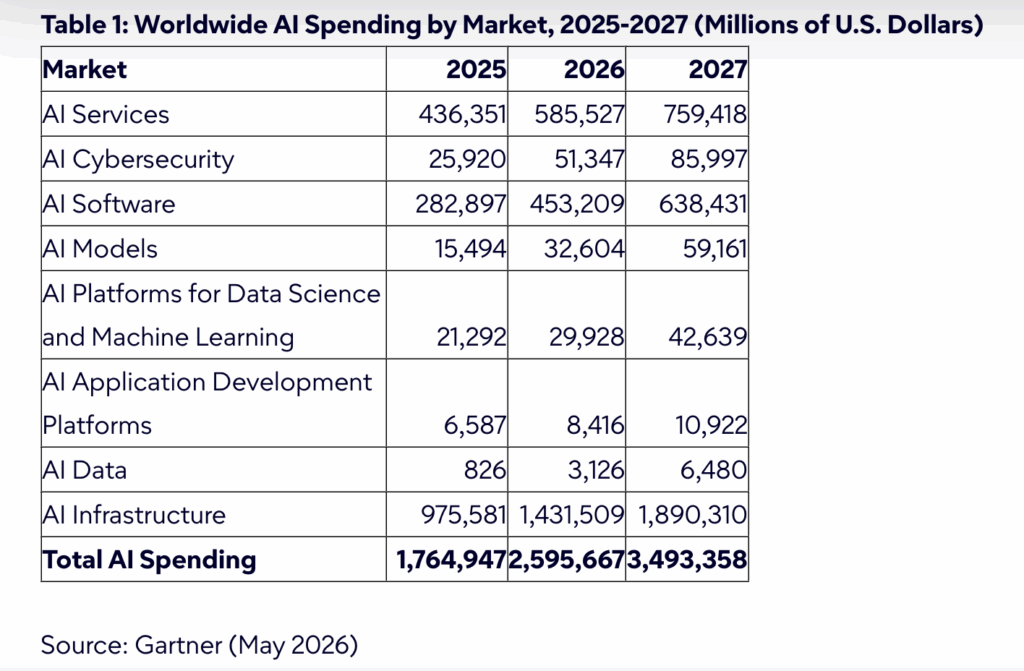
These figures point to an important change in the global technology market. The question for businesses is no longer simply whether they should adopt AI, but how deeply AI will become embedded into enterprise workflows, infrastructure, cybersecurity, and physical operations.
From autonomous AI agents to intelligent robots and industry-specific models, this article explores five technology market trends for 2026-2027 that business and technology leaders should understand.
Agentic AI Moves From Copilots to Autonomous Workflows
Generative AI dominated the technology conversation between 2023 and 2025. Early applications mostly focused on helping people generate content, summarize information, analyze documents, or write software.
The next stage is increasingly about Agentic AI.
Instead of waiting for individual prompts, AI agents can interpret objectives, plan tasks, access enterprise tools, retrieve information, and execute multi-step workflows with varying degrees of human supervision.
This represents one of the most significant technology market trends emerging in 2026.
IDC predicts that by 2027, 40% of job roles at large global enterprises will involve working with AI agents. However, adoption is still at an early stage. Deloitte reports that only around 11% of organizations currently have agentic AI solutions operating in production, while another 38% are running pilots.
The gap between experimentation and production suggests that 2026-2027 could become an important transition period.
From AI Assistant to AI Workforce
Traditional AI copilots typically support an employee. An AI agent can potentially participate directly in the workflow.
Consider a customer service process. Instead of simply suggesting a response to a support agent, an AI system could identify the customer, retrieve previous orders, check inventory, recommend a resolution, update the CRM, create a replacement order, and notify the customer.
Similar applications are emerging across industries:
- Banking and financial services: Fraud investigation, compliance monitoring, credit analysis, and document processing.
- Retail and eCommerce: Customer service, personalized shopping, product recommendations, and inventory decisions.
- Manufacturing: Procurement, production planning, quality management, and maintenance coordination.
- Logistics: Inventory allocation, route planning, and exception management.
- Software development: Coding, testing, documentation, and DevOps automation.
- Healthcare: Scheduling, clinical documentation, administrative workflows, and research support.
The evolution from AI copilots to autonomous workflows could therefore change more than individual productivity. It may reshape how businesses design processes and distribute work between people and machines.
For organizations exploring Agentic AI, the critical challenge will not simply be building more capable agents. Enterprises must determine where autonomy creates measurable value, which actions require human approval, and how agents interact safely with existing enterprise systems.
Physical AI Brings Intelligence Into the Real World
Another major shift in technology market trends 2026–2027 is taking AI beyond digital environments.
Generative AI operates primarily through software. Physical AI combines artificial intelligence with robots, sensors, cameras, vehicles, industrial equipment, and other machines capable of interacting with real-world environments.
Gartner identified Physical AI among its Top Strategic Technology Trends for 2026.
Meanwhile, the World Economic Forum’s Future of Jobs research found that 58% of surveyed employers expect robotics and autonomous systems to transform their businesses by 2030.
The combination of increasingly capable AI models, computer vision, robotics, IoT sensors, and edge computing is accelerating this development.
Manufacturing and Logistics Lead Physical AI Adoption
Factories and warehouses provide particularly suitable environments for Physical AI because many activities involve repetitive physical tasks combined with complex operational decisions.
Potential applications include:
Autonomous material handling: Robots can transport components between production areas based on real-time production demand.
AI-powered quality inspection: Computer vision systems can identify product defects and support more consistent inspection across production lines.
Predictive maintenance: Machine data can help AI systems detect abnormal patterns and schedule maintenance before equipment failures occur.
Warehouse robotics: Autonomous mobile robots can support picking, sorting, storage, and fulfillment operations.
Amazon, for example, announced the deployment of its one-millionth robot in 2025. Its DeepFleet AI model is designed to coordinate robot movement across fulfillment centers and improve robot travel efficiency by approximately 10%.
Physical AI Applications Across Industries
Physical AI extends well beyond factories.
In healthcare, robotics can support surgery, rehabilitation, hospital logistics, and patient monitoring.
In agriculture, autonomous equipment, drones, computer vision, and sensor networks can support precision farming and crop monitoring.
In retail, computer vision and robotics can assist with inventory scanning, fulfillment, and increasingly automated store operations.
In the automotive and transportation industries, AI is becoming more closely integrated with vehicles, manufacturing systems, and autonomous mobility technologies.
The larger change is straightforward: AI is gradually moving from understanding the physical world to acting within it.
AI Infrastructure Becomes the Next Technology Investment Wave
The rapid expansion of AI applications creates another challenge: infrastructure.
Training and operating advanced AI models requires significant computing capacity, storage, networking, energy, and specialized chips. As enterprise AI usage grows, the infrastructure supporting it is becoming a major technology market in its own right.
Gartner forecasts worldwide spending on data center systems to reach approximately $822 billion in 2026, representing growth of more than 60% year over year.
Infrastructure-as-a-Service spending is also expected to reach approximately $287 billion, growing around 29%.
The expansion becomes even clearer when looking specifically at AI.
Gartner projects global AI infrastructure spending to rise from approximately:
- $976 billion in 2025
- $1.43 trillion in 2026
- $1.89 trillion in 2027
This makes infrastructure one of the most important components of current technology market trends.
From Cloud-First to AI-Optimized Hybrid Infrastructure
For more than a decade, cloud-first strategies dominated enterprise technology modernization.
AI is making infrastructure decisions more complicated.
Different AI workloads have different requirements for computing power, latency, security, cost, and data governance. Building an AI-ready data infrastructure therefore becomes increasingly important for organizations moving from isolated AI experiments toward production-scale applications.
Organizations increasingly need to determine where each workload should operate across:
Public Cloud → Private Cloud → On-Premise Infrastructure → Edge
A retailer might run customer-facing AI services in the cloud while processing computer vision data locally inside stores.
A manufacturer could operate AI models close to factory equipment where latency matters.
A bank might maintain sensitive models and financial data within tightly controlled private infrastructure.
This is contributing to the rise of hybrid computing architectures, where workloads operate across different computing environments depending on business requirements.
Why Edge AI Is Becoming More Important
Edge AI brings computation closer to the location where data is generated rather than continuously transferring information to centralized cloud environments.
This approach can become particularly relevant when operations require low latency, intermittent connectivity, real-time responses, or stronger control over sensitive data.
Manufacturing equipment, connected vehicles, retail stores, telecommunications infrastructure, and medical devices are examples where edge processing can complement centralized AI infrastructure.
For industries such as manufacturing, automotive, telecommunications, healthcare, and retail, infrastructure architecture could therefore become an important part of AI strategy rather than simply an IT decision.
Cybersecurity Evolves for the AI Era
AI creates opportunities for enterprises, but it also expands the attack surface. Traditional enterprise cybersecurity primarily protects users, applications, networks, endpoints, and data.
AI-driven enterprises must increasingly protect another layer: AI models, AI agents, prompts, training data, identities, and automated actions.
This is why cybersecurity remains a critical technology market trend for 2026 and beyond.
Gartner has identified AI Security Platforms as a strategic technology trend for 2026, highlighting emerging risks including prompt injection, sensitive data leakage, and unauthorized AI-agent actions.
Investment is growing accordingly.
Gartner forecasts spending associated with AI cybersecurity to increase from approximately $25.9 billion in 2025 to $51.3 billion in 2026 and $86 billion in 2027.
AI Creates a New Enterprise Attack Surface
The cybersecurity implications become more significant as AI systems gain access to enterprise applications and data.
An AI assistant that summarizes a document has limited operational authority.
An AI agent connected to CRM, ERP, financial systems, APIs, customer databases, or cloud infrastructure could have considerably greater access.
Organizations therefore need to answer new questions:
- What information can an AI agent access?
- Which systems can it modify?
- What actions require human approval?
- How is an AI agent’s identity authenticated?
- How can autonomous actions be logged and audited?
Securing AI Agents and Autonomous Actions
These requirements are likely to increase attention around technologies and practices such as Zero Trust architectures, AI governance, machine identity management, confidential computing, data security, and AI security platforms.
Security architecture may also need to evolve from managing human identities alone to governing both human and machine identities.
The issue will be particularly significant for highly regulated industries including banking, healthcare, insurance, government, and enterprise software.
As AI becomes more autonomous, cybersecurity must increasingly move from protecting information to governing what intelligent systems are allowed to do with that information.
Domain-Specific AI Brings Intelligence Closer to Industry Workflows
The first generation of enterprise Generative AI adoption largely relied on general-purpose large language models.
But businesses rarely operate on general knowledge alone.
Healthcare organizations work with clinical terminology and patient records. Banks operate under complex financial regulations. Manufacturers rely on engineering specifications, production data, bills of materials, and supply chain information.
This is driving another important development within technology market trends: the rise of domain-specific AI.
Instead of trying to create one AI model capable of handling every possible task, organizations can combine foundation models with specialized enterprise data, industry knowledge, retrieval systems, and business rules.
Gartner predicts that by 2028, more than half of the Generative AI models used by enterprises will be domain-specific.
Why General-Purpose AI Is Not Enough
General-purpose AI models provide broad capabilities, but enterprise decisions often depend on context that does not exist in publicly available training data.
A manufacturer’s production constraints, a bank’s internal risk policies, a retailer’s inventory position, or a software company’s technical documentation can all contain proprietary knowledge.
This creates a growing need to connect AI with trusted enterprise knowledge.
Technologies such as Retrieval-Augmented Generation (RAG), knowledge engineering, vector databases, enterprise data platforms, and governance frameworks can help organizations ground AI outputs in relevant internal information.
The competitive advantage may therefore come less from access to the largest model and more from how effectively organizations connect AI with proprietary data, expertise, and workflows.
Domain-Specific AI Applications by Industry
Healthcare
AI systems can combine medical knowledge with clinical data to support documentation, research, administrative workflows, and clinical decision support.
Financial Services
Domain-specific models can analyze financial documents, transactions, regulations, and risk information to support compliance, fraud detection, and financial analysis.
Manufacturing
AI can connect information from ERP, MES, IoT, maintenance, and engineering systems to support production planning, quality control, and operational optimization.
Retail
Customer, transaction, inventory, and behavioral data can enable more advanced personalization, merchandising, demand forecasting, and customer service.
Software and Technology
AI connected to company-specific codebases, technical documentation, APIs, and product knowledge can assist development teams and customer support operations.
As organizations move beyond generic AI experimentation, industry context and proprietary knowledge could become increasingly important differentiators.
How Technology Market Trends Will Affect Different Industries
The five major technology market trends will not affect every sector equally.
Manufacturing and logistics are particularly exposed to the convergence of Agentic AI and Physical AI because they combine complex information workflows with physical operations.
Financial services and healthcare are likely to see strong adoption of domain-specific AI while simultaneously facing higher requirements for security, privacy, governance, and regulatory compliance.
Retail and eCommerce could benefit from Agentic AI across customer experience, merchandising, inventory management, and fulfillment.
Technology and SaaS companies, meanwhile, are likely to experience major changes across software engineering, infrastructure, customer support, and product development.
|
Industry |
Key Technology Trends |
Potential Applications |
| Manufacturing | Agentic AI, Physical AI, Edge AI | Production planning, robotics, quality control, predictive maintenance |
| Retail & eCommerce | Agentic AI, Domain AI, Physical AI | Personalization, customer service, merchandising, fulfillment |
| Financial Services | Agentic AI, Domain AI, AI Security | Risk analysis, fraud detection, compliance, process automation |
| Healthcare | Domain AI, Physical AI, AI Security | Clinical support, research, robotics, administration |
| Logistics | Agentic AI, Physical AI, Edge AI | Route planning, warehouse automation, inventory allocation |
| Software & SaaS | Agentic AI, AI Infrastructure, AI Security | Software development, testing, support, AI-native products |
Across industries, however, the same underlying transformation is emerging:
AI is moving from a standalone tool toward an operational layer across the enterprise.
What Should Business Leaders Prepare for in 2027?
Following the latest technology market trends does not mean businesses need to adopt every emerging technology.
The more important question is whether the organization has the foundations required to use these technologies effectively.
Build an AI-Ready Data Foundation
AI systems cannot consistently deliver reliable outcomes when enterprise data is fragmented, inaccessible, poorly governed, or duplicated across disconnected systems.
Organizations should therefore evaluate data architecture, integration, quality, governance, and accessibility before attempting to scale advanced AI applications.
Reassess Infrastructure Requirements
Infrastructure decisions increasingly need to account for workload performance, cost, latency, security, data sovereignty, and regulatory requirements.
The optimal architecture may involve a combination of cloud, private infrastructure, and edge computing rather than a single environment.
Establish AI Governance and Security
As AI systems gain more autonomy, organizations need clear rules defining what AI can access, which actions it can execute independently, and where human approval remains necessary.
Governance should therefore evolve alongside AI capabilities rather than being introduced after deployment.
Prepare the Workforce for Human-AI Collaboration
Technology transformation is ultimately also a workforce transformation.
The World Economic Forum reports that 86% of employers expect AI and information-processing technologies to transform their businesses by 2030. Its research also highlights skills gaps as a major barrier to technology adoption.
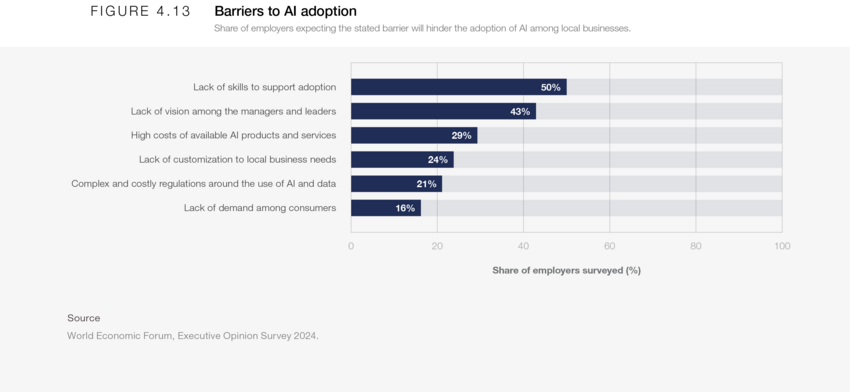
Organizations therefore need to consider not only which tasks AI can automate, but how roles, responsibilities, processes, and skills should evolve around increasingly intelligent systems.
The businesses that benefit most from the next technology cycle may not necessarily be those adopting AI fastest. They may be those that integrate AI most effectively with their data, people, processes, and technology architecture.
Conclusion
The defining technology market trends of 2026–2027 share a common direction.
- Agentic AI is giving software greater autonomy.
- Physical AI is bringing intelligence into factories, warehouses, vehicles, and other real-world environments.
- AI infrastructure is expanding to provide the computing foundation these systems require.
- Cybersecurity is evolving to govern a world where machines increasingly access data and execute actions.
- And domain-specific AI is connecting advanced models with the specialized knowledge that drives individual industries.
Together, these developments suggest that enterprise technology is entering a new phase.
For years, digital transformation focused primarily on connecting systems, digitizing processes, and making information accessible.
The next phase is increasingly about turning that digital foundation into intelligent operations, where systems not only record and analyze what is happening, but increasingly help businesses decide and act.
For organizations planning their technology strategy for 2027 and beyond, the challenge is therefore no longer simply identifying the next emerging technology. It is building the data, infrastructure, security, governance, and operating model required to turn emerging technologies into measurable business value.
Let’s contact us to discuss further!
FAQs
What are the biggest technology market trends for 2026-2027?
The major technology market trends for 2026-2027 include Agentic AI, Physical AI and intelligent robotics, AI-optimized infrastructure, AI cybersecurity, and domain-specific AI. Together, these trends reflect a broader shift from standalone digital tools toward intelligent systems embedded directly into enterprise operations.
What technology will have the biggest impact on businesses in 2027?
Artificial intelligence is expected to remain one of the most influential technologies, but its impact is expanding beyond Generative AI into autonomous agents, robotics, industry-specific models, and AI-optimized infrastructure. The World Economic Forum reports that 86% of surveyed employers expect AI and information-processing technologies to transform their businesses by 2030.
Which industries will be most affected by emerging technology trends?
Manufacturing, financial services, healthcare, retail, logistics, telecommunications, and software are among the industries likely to experience significant changes. The nature of adoption will differ: manufacturing and logistics may see greater Physical AI adoption, while finance and healthcare are likely to emphasize domain-specific AI, security, privacy, and governance.
How should companies prepare for technology trends in 2027?
Companies should focus on building strong foundations rather than adopting every emerging technology. Priorities include improving data quality and accessibility, modernizing infrastructure, strengthening cybersecurity and AI governance, identifying high-value workflows for automation, and developing the skills required for effective human-AI collaboration.