


What Is AI Strategy Consulting – And What Should It Actually Deliver in 2026?

TABLE OF CONTENT
What Is AI Strategy Consulting?
Why AI Strategy Consulting Engagements Fail: Four Patterns Worth Knowing
What Good AI Strategy Consulting Looks Like: A 5-Phase Framework
AI Advisory vs. AI Transformation Consulting: The Difference That Matters
5 Questions to Ask Before Hiring an AI Strategy Consultant
Conclusion
Most enterprise AI projects die in the pilot phase. Gartner research consistently puts that number at around 80%. The usual culprit is not the model, the GPU budget, or even the data. It is the absence of a coherent strategy that connects what the business actually needs to systems that someone can actually build and operate. That is where AI strategy consulting comes in. This article explains what a real engagement looks like, what it should produce, and the five questions worth asking before you sign.
What Is AI Strategy Consulting?
AI strategy consulting is a professional service that aligns an organization’s AI investment with its business objectives and produces a roadmap to production. The key word is production. Strategy that stops at the roadmap level is just expensive planning.
A real AI strategy engagement answers three things the business cannot answer alone: which AI use cases are worth pursuing given the company’s data and infrastructure reality, which architecture and tooling choices make sense for this specific environment, and what the path from pilot to production actually looks like over the next 90 days.

Three deliverables any serious AI strategy engagement must produce:
- Use case prioritization: A ranked list of AI opportunities scored by business impact, technical feasibility, data readiness, and compliance risk. Not every idea. The five worth building first.
- Technical architecture decision: A written recommendation on build vs. buy vs. platform, model selection rationale, and infrastructure requirements. Agnostic to vendor.
- 90-day pilot-to-production roadmap: Specific milestones, measurable KPIs, resource requirements, and a named owner for each stage. If the roadmap cannot survive contact with your engineering team, it was never a real roadmap.
The McKinsey State of AI 2025 report found that the fastest-moving AI adopters share one trait: they connect strategic decisions to specific technical choices from the start. Companies that treat strategy and implementation as sequential hand-offs are consistently slower to production.
Why AI Strategy Consulting Engagements Fail: Four Patterns Worth Knowing
Not every AI strategy engagement produces value. Some produce impressive-looking reports that nobody acts on. Here are the failure modes that appear most often.
Strategy Disconnected from What Can Actually Be Built
The most common failure: the strategy document arrives, and then the engineering team reads it and has no idea where to start. Good enterprise AI consulting accounts for your actual engineering capacity, your data pipeline state, and your existing tooling before recommending anything. Strategy that ignores implementation constraints is fiction dressed up as planning.
No Concrete Platform or Tooling Recommendation
‘Explore large language models for your use cases’ is not strategic advice. It is intellectual hedging. A serious AI advisory services engagement names specific tools, explains the tradeoffs between them, and tells you which one fits your requirements and why. Vague technology recommendations produce vague results.
Data Readiness Goes Unassessed
Gartner puts 85% of AI project failures at the feet of data issues, not model selection. Any strategy that does not audit your data pipeline coverage, data quality, and governance posture before recommending use cases is skipping the part that actually determines whether those use cases will work. We have seen companies commission detailed AI roadmaps for use cases that their data infrastructure could not support for another 18 months.
Change Management Is an Afterthought
68% of business leaders cite talent gaps as their primary barrier to AI adoption (IBM Institute for Business Value, 2025). AI strategy that does not address organizational design, upskilling, and cross-functional alignment will hit a human wall before it reaches a technical one. The best strategy in the world does not survive a team that was never bought in.
What Good AI Strategy Consulting Looks Like: A 5-Phase Framework
The following framework reflects how serious AI transformation consulting engagements are structured. Each phase has specific outputs, not just activities.
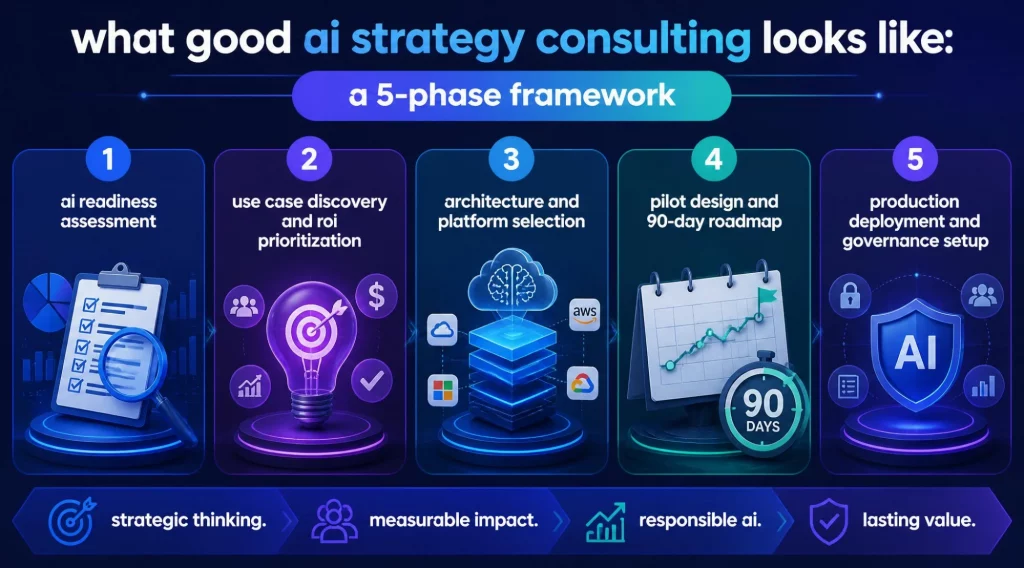
Phase 1: AI Readiness Assessment
This phase audits four dimensions: data maturity (coverage, quality, governance), infrastructure capability (compute, integration readiness), team expertise (what skills exist, what is missing), and compliance exposure (GDPR, HIPAA, SOC 2, sector-specific requirements). The output is a scored readiness assessment with a gap list. Without this, every recommendation that follows is guesswork.
Phase 2: Use Case Discovery and ROI Prioritization
Potential AI use cases get evaluated against a consistent scoring framework: business impact size, technical feasibility, data availability, time to production, and compliance risk. You leave with a ranked backlog of the top five to ten use cases, each with a rough ROI model. This replaces the usual whiteboard wishlist with something an executive committee can actually approve.
Phase 3: Architecture and Platform Selection
Which LLMs? What deployment model? Build, buy, or use a platform? A model-agnostic approach matters here. The right architecture depends on your latency requirements, compliance obligations, cost model, and in-house engineering depth. Recommending GPT-4o because everyone else is using it is not architecture consulting.
Phase 4: Pilot Design and 90-Day Roadmap
The pilot is not a demo. It is a production-intent deployment on a scoped use case, with defined success metrics, a rollback plan, and a timeline that connects directly to your first production release. The 90-day roadmap specifies who does what, in what order, and how progress will be measured.
Phase 5: Production Deployment and Governance Setup
Production deployment includes monitoring thresholds, retraining triggers, audit logging, and access controls. Governance setup covers model versioning policy, PII handling procedures, compliance documentation, and the operational process for running the system after launch. This is where most pure-advisory firms hand off to someone else. Firms that do both are significantly more likely to see the project through to production.
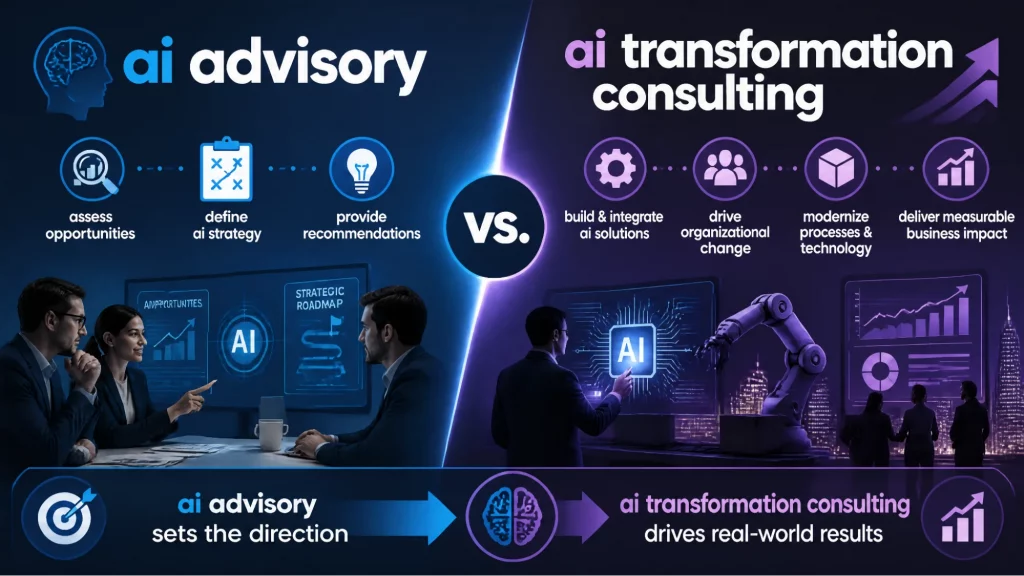
AI Advisory vs. AI Transformation Consulting: The Difference That Matters
These two terms get used interchangeably. They should not be.
|
Dimension |
AI Advisory Services |
AI Transformation Consulting |
| Primary output | Strategic direction and recommendations | Working AI system in production |
| Who delivers it | Strategy consultants, sometimes analysts | Strategy + engineering + change management |
| What happens after | Handoff to internal team or another vendor | Continuous delivery through production |
| Time horizon | 4–8 weeks for strategy phase | 3–18 months end-to-end |
| Cost signal | Lower upfront, higher implementation risk | Higher upfront, lower delivery failure risk |
| Best fit | Organizations evaluating AI options | Organizations ready to build and ship |
The most effective engagements combine both. Pure advisory without implementation ownership produces strategy documents. Pure implementation without strategy produces isolated pilots that cannot scale. According to Deloitte’s 2025 AI Adoption Report, organizations that integrate strategy and implementation in a single engagement are 2.3x more likely to reach production within six months.
| AHT Tech combines AI strategic advisory with hands-on delivery. From AI readiness assessment through production agent deployment, we work model-agnostic and compliance-first. Contact us for further discussion! |
5 Questions to Ask Before Hiring an AI Strategy Consultant
These questions separate firms that talk about AI from firms that deploy it. Run every shortlisted vendor through them before signing.
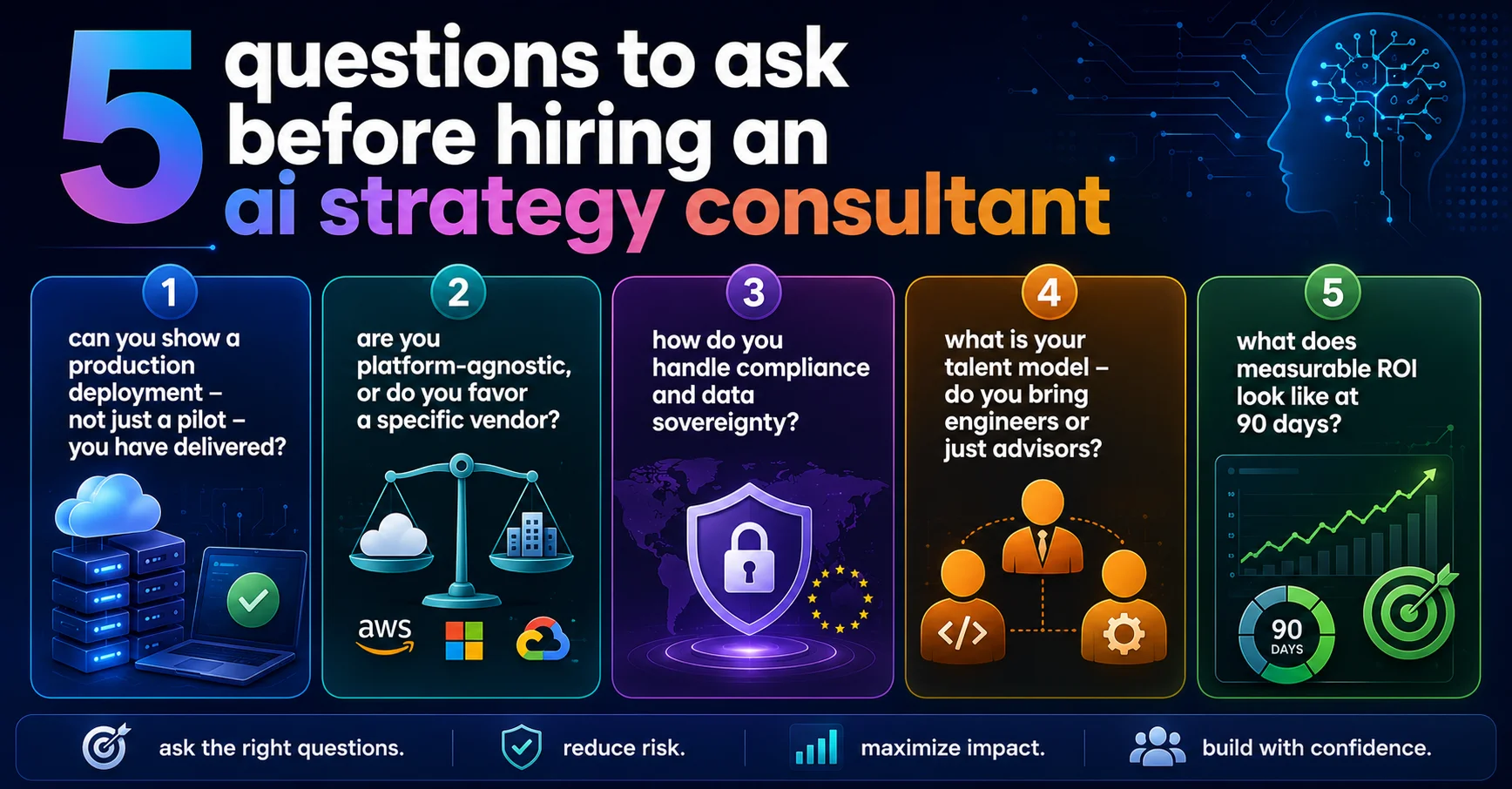
- Can you show a production deployment – not just a pilot – you have delivered?
References to sandbox demos do not count. Ask for a named production deployment, the use case, and a measurable outcome. If they cannot name one, keep looking.
- Are you platform-agnostic, or do you favor a specific vendor?
A firm that recommends the same LLM stack to every client is selling a product, not a strategy. Model-agnostic consultants evaluate GPT-4o, Claude, Gemini, and Llama against your specific requirements and choose accordingly.
- How do you handle compliance and data sovereignty?
For BFSI, healthcare, or any regulated industry, ask specifically about GDPR, HIPAA, and on-premise deployment options. If the consultant cannot explain air-gapped deployment, that is a gap that will cost you later.
- What is your talent model – do you bring engineers or just advisors?
Strategy without engineering capacity means you need a second vendor to implement. Ask whether the firm’s AI engineers are involved in the engagement or whether they hand off to your internal team.
- What does measurable ROI look like at 90 days?
A 90-day benchmark tells you whether the consultant plans for production. A firm that cannot describe what success looks like at 90 days is not thinking in deployment terms.
The fifth question is the most revealing. Most AI implementation consulting failures are not technical. They happen because nobody agreed on what success looked like before the engagement started.
Conclusion
AI strategy consulting only earns its cost when it ends with systems in production. A strategy document that sits in a shared drive is not an asset. A production-deployed AI system that reduces processing time, cuts error rates, or recovers analyst hours is.
The firms that deliver this outcome consistently are the ones that connect strategic direction to engineering execution from the first meeting. They bring model-agnostic architecture thinking, compliance-first design, and implementation capacity under the same engagement.
AHT Tech’s AI advisory practice is built on 18 years of enterprise infrastructure delivery. We pair strategic consulting with hands-on deployment, using our AI Hive platform as the delivery layer for clients who need to move from strategy to production without switching vendors halfway through.
| Book a free AI Strategy Session with AHT Tech. We will assess your AI readiness, identify your three highest-ROI use cases, and map a 90-day path to your first production deployment. |
FAQs
What does AI strategy consulting cost?
Engagements range from $30,000 for a focused readiness assessment to $250,000+ for a full transformation engagement. A readiness-through-roadmap engagement for a mid-market firm typically runs $40,000-$80,000. Full transformation programs for large enterprises run considerably higher. Cost scales with organization size, use case complexity, and whether implementation is included.
How long does an AI strategy engagement take?
Strategy-only engagements (readiness through roadmap) typically run 4-8 weeks. Engagements that extend through pilot deployment take 3-6 months for well-scoped use cases. Full organizational transformation programs run 12-18 months.
What is an AI readiness assessment?
An AI readiness assessment audits your organization’s capability to deploy AI across four dimensions: data quality and availability, infrastructure and tooling, team expertise, and compliance or regulatory exposure. The output is a gap analysis and a prioritized list of prerequisites before AI deployment begins.
AI consulting vs. building an in-house AI team - which is better?
Building in-house costs $500,000 to $2M in recruitment, salary, and tooling, with a 12–18 month ramp time before the team can ship anything. AI strategy consulting provides immediate expertise and accelerates time-to-production. Most enterprises use a hybrid model: consulting for initial strategy and delivery acceleration, with internal team ownership after production is established.
Which industries benefit most from AI strategy consulting?
Financial services, healthcare, manufacturing, and legal consistently show the highest ROI from structured AI strategy engagements. These industries share the same profile: complex compliance requirements, large volumes of unstructured data, and high-value repetitive processes where automation has a clear and measurable impact.